



On April 12, 2026, the motorsport world stopped. Not for a race. Not for an announcement. But for a two and a half minute trailer that promised to revive the exact moment when Michael Schumacher stopped being unknown to become a legend. The short film is called “The Kaiser”, and although it still has no confirmed release date or guaranteed distribution, it has already generated more conversation than most Hollywood productions.
Table Of Content
- A fan director and a clear vision
- Production: artisanal, authentic, no artificial intelligence
- The cast: astonishing resemblances and a legend’s son
- The story: 48 hours that changed everything
- The context: beyond Netflix
- The challenge: financing and distribution
- The reception: divided emotions
- The moment: why now?
- Technical data and project curiosities
- The legacy before existing
Because this is not a Hollywood production. It is an independent Bulgarian project, directed by a 29 year old fan who grew up watching Formula 1 races on television and decided that the story of Schumacher’s debut deserved to be told in a way no one had attempted before.
A fan director and a clear vision
Lubo Marinov is 29 years old. He is Bulgarian. And until a few months ago, very few people in the film or motorsport world knew who he was. But Marinov had something the major studios did not: genuine obsession with a specific moment in Formula 1 history.
“I grew up watching Michael Schumacher and, like many, admired his approach, his discipline and the way he transformed motorsport,” Marinov told Infobae in August 2025, when the project was just beginning to take shape. “But I always felt that the early years of his story, before Ferrari, before the titles, were very under-explored. I wanted to capture that turning point when a young driver becomes a legend.”
That turning point has an exact date and place: August 25, 1991, Spa-Francorchamps, Belgium. The Grand Prix where Michael Schumacher, at 22 years old, made his Formula 1 debut with the Jordan team, replacing Bertrand Gachot, who was in prison following an altercation with a London taxi driver.
Marinov did not want to make a documentary. An excellent one already existed on Netflix since 2021. Nor did he want to make a complete biography. He wanted something more specific, more intimate, more cinematic: the 48 hours that changed the life of a young German from a town called Kerpen and, with it, the history of Formula 1.
Production: artisanal, authentic, no artificial intelligence
“The Kaiser” is produced by Grey Universe Ltd. in collaboration with B2Y Productions, NFK and A1. It is a short film of approximately 20-25 minutes duration, although the declared intention is to turn it into a feature film if they secure additional financing. For now, what exists is a proof of concept. A trailer that functions as a presentation card to investors and studios.
And that proof of concept is impressive.
The trailer, published on the official website thekaiserfilm.com and on social media on April 12, 2026, includes a warning that in the era of generative artificial intelligence is almost revolutionary: “Created using traditional filmmaking techniques. No generative AI was used.”
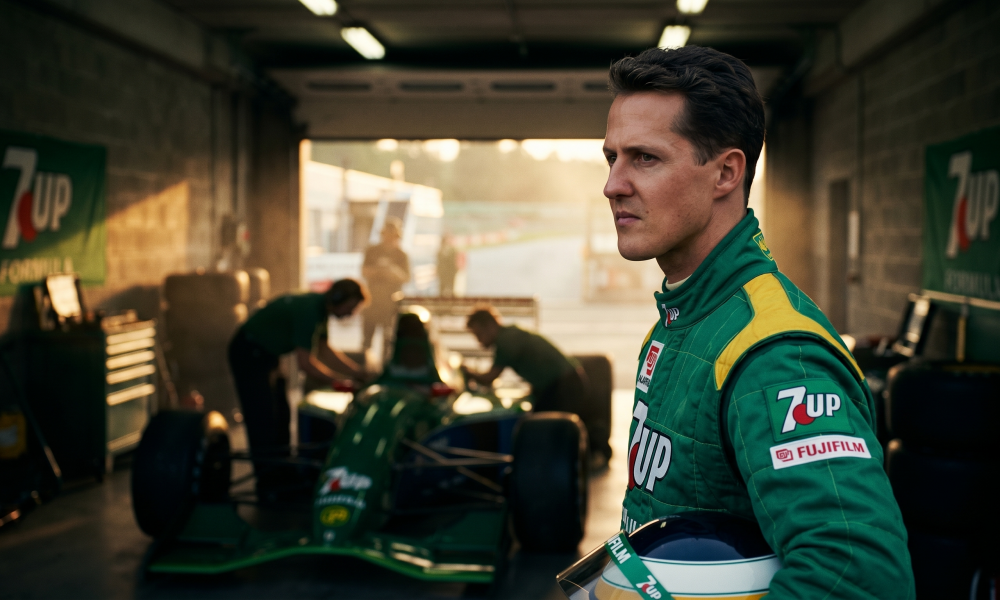
Every frame was filmed with real actors, on real sets, with a functional replica of the Jordan 191 built from scratch. That replica, the work of Marinov’s father and a group of Bulgarian artisans, took six months to manufacture and is functionally identical to the car Schumacher drove that day at Spa.
The level of detail is obsessive. The production team recreated the Jordan 1991 box with historical precision. The uniforms, helmets, tools, corporate colors of the sponsors. Everything is there. Marinov studied photographic archives, videos from the time, interviews, technical reports. He even consulted with people who were at Spa that weekend.
“I like motorsport, but even more I am attracted to the human stories behind greatness,” Marinov explained. “Schumacher’s debut in 1991, the sudden appearance at Spa and his rivalry with Senna: it’s a perfect combination of ambition, uncertainty and innate talent.”
The cast: astonishing resemblances and a legend’s son
The role of Michael Schumacher is played by Jivko Sirakov, a relatively unknown Bulgarian actor who bears a remarkable physical resemblance to the German driver in his youth. The trailer images show that similarity in a disturbing way: the same facial structure, the same intensity in the gaze, the same way of holding the helmet.
Raymond Steers plays Willi Weber, the manager who discovered Schumacher in karting and took him to Formula 1. Dimiter D. Marinov brings Eddie Jordan to life, the Irish businessman whose team gave Schumacher his first opportunity (although critics have pointed out that his attempt at an Irish accent leaves much to be desired).
Viktoria Antonova plays Corinna Betsch, who in 1991 was not yet Michael’s wife but was already an important part of his life. And in the role of Ayrton Senna appears Kristo Stoichkov, son of legendary Bulgarian footballer Hristo Stoichkov, winner of the Ballon d’Or in 1994.
That choice is not coincidental. The trailer shows a red flag waving, a direct reference to the 1994 San Marino Grand Prix at Imola, where Senna lost his life. Although the film focuses on 1991, the creators have confirmed that they explore the initial relationship between Schumacher and Senna, two drivers who never became friends but deeply respected each other.
The story: 48 hours that changed everything
On Friday, August 23, 1991, Michael Schumacher had no seat in Formula 1. He was a driver in Mercedes’ sportscar program, had won the German Formula 3 championship in 1990, but nobody in the paddock really knew him.
That same Friday, Bertrand Gachot, Belgian driver for the Jordan team, was in a cell in London. He had sprayed pepper spray on a taxi driver during a traffic altercation and was arrested. Eddie Jordan urgently needed a replacement for the Belgian Grand Prix, which was being run on Sunday at Spa-Francorchamps.
Willi Weber, Schumacher’s manager, received the call. The problem: Michael had never raced at Spa. He had never driven a competitive Formula 1 car. Jordan asked him if he knew the circuit. Weber lied. He said yes.
On the Tuesday before the race, Schumacher had his first test with the Jordan. On Thursday he arrived at Spa. On Friday he had his first free practice session. On Saturday he qualified seventh. Seventh. In his first weekend. On a circuit he did not know. In a car he had driven barely a few hours.
That Saturday night, Flavio Briatore, head of the Benetton team, was already negotiating with Weber to take Schumacher. Eddie Jordan had a verbal agreement but no signed contract. Briatore knew it. And he acted.
On Sunday, August 25, Schumacher started seventh. In the first corner he overtook Nelson Piquet and Jean Alesi, two world champions. Five hundred meters later, the Jordan’s clutch failed. Schumacher retired. But it was already too late. The world had seen him. And Briatore already had the contract ready.
Years later, Schumacher revealed: “We had problems in Sunday’s warm-up. I pointed it out, but Eddie said it would cost too much money to fix it. Then it broke in the race.”
Jordan tried to obtain an injunction to prevent Schumacher from racing for Benetton in the next race at Monza. He failed. The following Tuesday, Michael Schumacher was already a Benetton driver. And the rest is history.
Those 48 hours are the heart of “The Kaiser”. Marinov does not want to tell Schumacher’s entire career. He wants to tell the exact moment when an unknown young man became the obsession of the entire paddock.
The context: beyond Netflix
In 2021, Netflix premiered “Schumacher”, the family-authorized documentary that reviewed the entire career of the German driver and delicately addressed his 2013 skiing accident. That documentary was emotional, well-produced, and featured exclusive interviews with Corinna, Mick, Gina-Maria, Jean Todt, Sebastian Vettel and others close to him.
But “Schumacher” was a documentary. Archival images, testimonies, voiceover narration. “The Kaiser” is something else. It is narrative fiction based on real historical events. Actors playing characters. Imagined dialogues but anchored in what we know happened. Cinematography, soundtrack, dramatic editing.
“Created as a proof of concept for a future feature film, The Kaiser blends real historical events with immersive storytelling, capturing the intensity, pressure, and humanity behind the helmet,” explains the project’s official synopsis.
It is a cinematic approach reminiscent of “Senna”, the acclaimed 2010 documentary about Ayrton Senna directed by Asif Kapadia, but with actors instead of pure archive footage. Or “Rush”, Ron Howard’s film about the rivalry between Niki Lauda and James Hunt in 1976.
The challenge: financing and distribution
So far, “The Kaiser” has no confirmed release date. Nor does it have guaranteed distribution. The trailer published in April 2026 is precisely that: a tool to attract investors and distributors.
According to previous statements by Marinov in August 2025, the original goal was to premiere the short film at the 2026 Berlin International Film Festival (the Berlinale, held in February), with a subsequent public release in late summer or autumn 2026.
However, recent sources indicate that the premiere could be postponed until autumn 2026, depending on whether they secure financing to turn the short film into a feature film before public distribution.
The paradox is that the trailer has already generated millions of views on social media. The Twitter account @GazzettaFerrari shared the video on April 12, 2026 with the caption: “A MICHAEL SCHUMACHER FILM IS COMING!!!” and the tweet immediately went viral. Media around the world replicated it. Schumacher fans, especially Ferrari tifosi, shared it massively.
The interest is there. The question is whether that interest will translate into real financing to complete the feature film Marinov envisions.
The reception: divided emotions
Reactions to the trailer have been intensely polarized. At one extreme, excited fans celebrating any production that honors Schumacher’s legacy. At the other, skeptics questioning whether an independent Bulgarian production company with no previous experience in motorsport can do justice to a story of this magnitude.
Comments on social media reflect that division:
“Finally someone tells this story. Schumi’s debut is legendary and nobody had taken it to the cinema.”
“It looks well produced, but can they really capture the tension of that moment with unknown actors?”
“The actor’s resemblance to Michael is incredible. I already want to see it.”
“Why didn’t they wait to have more budget? This looks like a fan production.”
Industry critics have pointed out that the project has potential but faces enormous obstacles. Sam Cooper, a Crash.net journalist who covered the trailer, commented: “The level of visual authenticity is impressive for such a small production. The Jordan 191 replica is remarkable. But the final success will depend on the script and performances, not just the aesthetics.”
Cooper also pointed out a specific problem: “Dimiter D. Marinov’s attempt to imitate Eddie Jordan’s Irish accent is, to be generous, questionable. The less said about it, the better.”
The moment: why now?
2026 marks 35 years since Schumacher’s Formula 1 debut. It also marks 20 years since his last grand prix victory (China 2006). And it marks more than 12 years since his skiing accident in Meribel.
In that context, any production about Schumacher carries an enormous emotional charge. The Schumacher family has maintained absolute silence about his health since 2014. Only a circle of approximately 9 people have access to him. Jean Todt, former FIA president and former Ferrari boss, regularly visits Michael but respects family privacy.
Corinna Schumacher stated in the 2021 Netflix documentary: “Michael always protected us. Now we protect him.” That phrase summarizes the family stance: total privacy protection, zero medical updates, zero public images.
In that information vacuum, projects like “The Kaiser” serve an almost therapeutic function for fans. They cannot know how Michael is today. But they can relive the moment when Michael was invincible, young, hungry, unstoppable.
“The Kaiser” does not pretend to be a current documentary about Schumacher’s condition. It does not touch on the 2013 accident. It does not speculate about his health. It focuses exclusively on 1991, when everything was possible and the future had not yet been written.
Technical data and project curiosities
Duration: 20-25 minutes (short film). They plan to expand it to a 90-120 minute feature film.
Director: Lubo Marinov, 29 years old, Bulgarian, F1 fan since childhood.
Production companies: Grey Universe Ltd. (main), in collaboration with B2Y Productions, NFK and A1.
Main cast:
- Jivko Sirakov as Michael Schumacher
- Kristo Stoichkov as Ayrton Senna
- Dimiter D. Marinov as Eddie Jordan
- Raymond Steers as Willi Weber
- Viktoria Antonova as Corinna Betsch
Production technique: Traditional filming, no generative artificial intelligence. Physical replica of the Jordan 191 built by hand in six months.
Narrative approach: Historical drama based on real events, set specifically on the weekend of August 23-25, 1991 at Spa-Francorchamps.
Planned release: Autumn 2026 (no official confirmation). Original goal: 2026 Berlin Film Festival, but apparently postponed.
Distribution platform: Not yet confirmed. There is no agreement with Netflix, Amazon Prime, Apple TV+ or any other streaming service. There is also no guaranteed theatrical distribution.
Budget: Not publicly disclosed, but clearly modest compared to Hollywood productions.
Official website: thekaiserfilm.com
Official trailer: Published April 12, 2026. Approximate duration: 2 minutes 30 seconds.
The legacy before existing
What is extraordinary about “The Kaiser” is that it is already part of the conversation about Michael Schumacher before being released. The trailer has achieved something few independent productions achieve: immediate global attention.
Marinov has demonstrated that you do not need a Hollywood studio to capture the imagination of millions of motorsport fans. You need genuine passion, attention to detail and a story worth telling.
Will “The Kaiser” become the feature film Marinov envisions? Will it find distribution on global platforms? Will it do justice to Schumacher’s legend?
Nobody knows yet. But the two-and-a-half-minute trailer has already fulfilled its purpose: reminding the world that before the seven world titles, before the 91 grand prix wins, before becoming Ferrari’s most successful driver, there was a moment. One weekend. Forty-eight hours at Spa-Francorchamps where a 22-year-old German proved he was not just another driver.
He was the Kaiser. And his reign was just beginning.
Sources: Motorsport.com, Motorsport (edición en español), Sopitas.com, Infobae, El Español, Rosario3, Bolavip, Récord México, El Dictamen, 442 Perfil, Speedcafe.com, Crash.net, Scuderia Fans, Formula Live Pulse, Motorcycle Sports, Yahoo News Canada, The Kaiser Film Official Website (thekaiserfilm.com), La Gazzetta Ferrari (Twitter), Fórmula Directa (Twitter), Grey Universe Ltd. Official Statements

No Comment! Be the first one.