
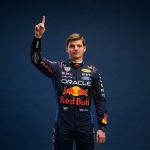
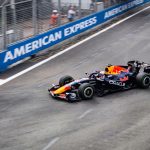



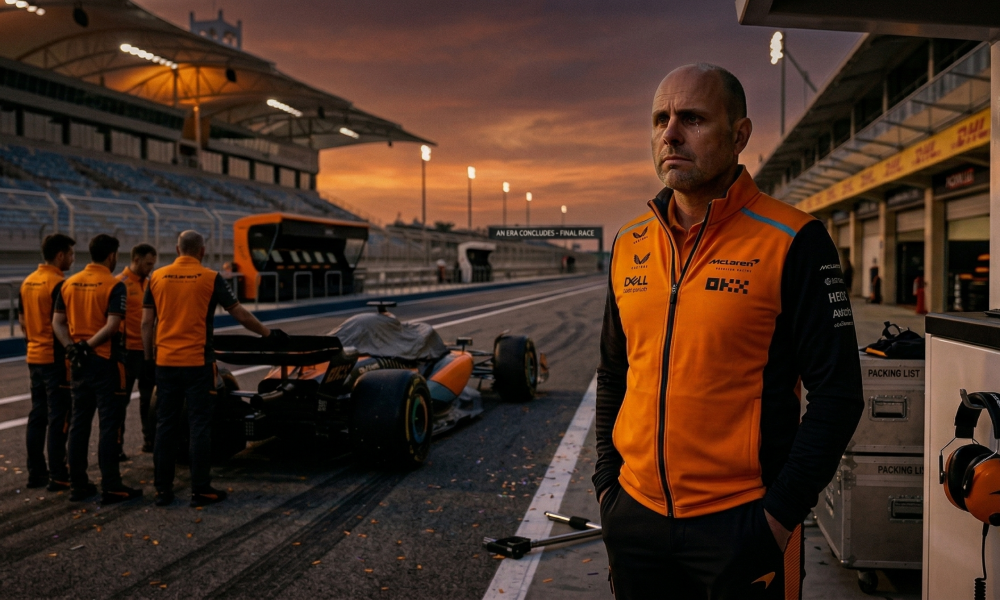
There are names in Formula 1 that everyone knows even though they have never driven a racing car. Ayrton Senna. Michael Schumacher. Max Verstappen. And then there are names only known to those who truly follow the sport, the ones behind the titles, the ones who speak to champions in their ear while the world watches the track. Gianpiero Lambiase is one of those names. Until today.
Because today, April 9th 2026, McLaren and Red Bull officially confirmed that the most recognisable race engineer in recent Formula 1 history is leaving the team that made him a legend to join the most powerful rival on the grid. And with that news, the entire paddock is asking the same question: if GP leaves, does Max leave too?
The beginnings: London, Cambridge and a rock band
Gianpiero Lambiase was born on October 14, 1980 in Bedford, England, to Italian parents. He grew up in London with dual nationality and the accent that betrays his northern Italian roots, even though his name sounds more like a Ferrari driver than a Milton Keynes engineer. From childhood he was a Chelsea supporter, just like his father. And from childhood he was also fascinated by Formula 1, though it took him years to find the right door in.
What very few people know is that Lambiase’s path to engineering was anything but direct. He studied at Cambridge, the same university where Red Bull strategy chief Hannah Schmitz was educated. But his first calling was not mechanics. Lambiase trained as an actor. And before becoming the most important man on Red Bull’s pit wall, he was the drummer of Torperstate, a Bedfordshire indie rock band that in 2003 finished second in the MTV European Unsigned Band Awards, achieved rotation on XFM and BBC Radio, and was included in a Daily Star compilation. The group dissolved that same year, its members went separate ways, and Lambiase found his path in mechanical engineering at University College London.
The story of the frustrated actor who became the most successful engineer in modern Formula 1 is real. And it says a great deal about a man who has always been, above all else, someone capable of adapting.
2005-2014: A decade of formation in the paddock trenches
In 2005, Lambiase entered Formula 1 through the smallest available door: the Jordan team as a tyre data engineer. It was not glamorous work. It was background work, telemetry analysis, setup configuration, learning inside a team that was fighting to survive at the bottom half of the grid.
What is extraordinary about Lambiase is that he stayed when no one would have blamed him for leaving. Jordan became Midland in 2006. Midland became Spyker in 2007. Spyker became Force India in 2008. Four names, four distinct corporate identities, four different budgets, but always the same man in the garage adapting to each new reality. While others sought larger teams and more secure salaries, Lambiase was building something more valuable than any contract: real experience under adverse conditions.
The turning point came at Spa-Francorchamps in August 2009. Lambiase was Giancarlo Fisichella’s performance engineer when the Italian qualified on pole position with the Force India, the team’s first historic result under that name. The next day Fisichella finished second in the race, another historic milestone. They were a team running on a tenth of Ferrari’s budget, and they had just taken pole at the most demanding circuit on the calendar. For Lambiase it was proof that great results do not require great teams. They require great people at the right moment.
Between 2010 and 2014 Lambiase was race engineer for Vitantonio Liuzzi, Paul di Resta and Sergio Pérez at Force India, accumulating experience with drivers of very different profiles and learning to communicate with each one in their own technical and human language.
2015-2016: The transition to Red Bull and the beginning of an era
At the end of 2014, Red Bull called Lambiase. The most dominant team in recent Formula 1 history needed a race engineer for their second driver. Lambiase left Force India, the team where he had grown for a decade, and made the leap to Milton Keynes.
His first season at Red Bull, 2015, he spent alongside Daniil Kvyat. Twenty-three races together. Correct, solid, nothing extraordinary. And then, in May 2016, Red Bull made a decision that changed the history of the sport: they replaced Kvyat with an 18-year-old who had only debuted in Formula 1 one year earlier with Toro Rosso. His name was Max Verstappen.
Lambiase and Verstappen met days before the 2016 Spanish Grand Prix. They had very little time to understand each other. And yet, on Sunday May 15th, at Circuit de Barcelona-Catalunya, the Dutch teenager won his first race with Red Bull. Verstappen became the youngest winner in Formula 1 history at 18. And Lambiase was on the other end of the radio.
2017-2020: Building the foundation of a future champion
The following years were years of accelerated learning for both of them. Verstappen was an extraordinary talent but also a driver with an explosive character, impatient, demanding to the limit. Lambiase learned quickly that the only way to work with him was in his own language: direct, without filters, without condescension.
The relationship had its moments of public tension. At the 2022 Emilia Romagna Grand Prix, Verstappen asked him to be quiet over the radio during the race. The next day it was Verstappen himself who sought out Lambiase in the paddock, brought him an ice cream and apologised. Christian Horner revealed this later, and that anecdote perfectly encapsulates who both of them are: capable of clashing, but also capable of admitting it.
What Lambiase gave Verstappen in those years was something no previous engineer had managed to give him: stability. The capacity to stay calm when the most intense driver on the grid needs precisely that. In the Red Bulletin, Lambiase explained his philosophy clearly: “The relationship between a driver and a race engineer is based on mutual trust. The more direct a driver is, the more he trusts the team. My experience is that if a driver stops giving his honest opinion about the car, the results get worse. Max is direct. And so am I.”
2021-2024: Four world titles and the summit of motorsport
On December 12, 2021, at the Yas Marina circuit in Abu Dhabi, Max Verstappen won his first world title in the most dramatic final lap in recent Formula 1 history. On the last lap, with Lewis Hamilton ahead, on fresh tyres, Verstappen passed the Mercedes champion and crossed the line as world champion. Lambiase was the one who communicated the changes to the Safety Car procedure that enabled the execution of that one-stop strategy. It was one of the most important and most controversial decisions in the history of the championship.
Then came three more titles. 2022, 2023 and 2024. Four consecutive. An unprecedented dominance that made Verstappen the fourth driver in history to win four world championships, and made Lambiase the silent architect of a dynasty. In September 2024, Red Bull formally recognised his role by promoting him to Head of Racing, a position of total leadership over the team’s entire sporting operation, while he continued as Verstappen’s race engineer on the pit wall.
2025-2026: The unravelling
And then everything began to change. Christian Horner was sacked. Adrian Newey left for Aston Martin. Jonathan Wheatley to Audi. Helmut Marko, the godfather of the junior driver programme and the man who had discovered Verstappen, left at the end of 2025. Rob Marshall and Will Courtenay had already been at McLaren for some time. Verstappen’s chief mechanic Matt Caller left for Audi in the winter. And Verstappen himself began talking about retirement.
In 2026, with the new regulations the champion described as “anti-racing” and “Formula E on steroids”, Red Bull arrived at the first round of the championship as the fifth or sixth team on the grid. Verstappen, ninth in the championship after three races, told the BBC he was seriously thinking about retiring at the end of 2026.
April 9, 2026: The definitive bombshell
This morning, McLaren and Red Bull officially confirmed what the Dutch media had broken in the previous hours. Gianpiero Lambiase will leave Red Bull at the end of his contract in 2027 and join McLaren as Chief Racing Officer, no later than 2028.
It is the third major signing of a former Red Bull figure by McLaren in a few years, after Rob Marshall as Technical Director and Will Courtenay as Sporting Director. McLaren is not just building the best car on the grid. It is building the organisational structure of Formula 1’s next dominant era. And to do so, it is systematically purchasing the best minds from the team that dominated the last era.
For Verstappen, the news carries a different weight. In 2021 he told Ziggo Sport: “I have said to him I only work with him. As soon as he stops, I stop too.” That phrase resonates today with a different intensity entirely.
Historic quotes and curiosities
These are the words that defined Lambiase over the years, published in verified media:
“The relationship between a driver and his engineer is based on mutual trust. The more direct a driver is, the more he trusts the team.” Red Bulletin, Verstappen Edition.
“The day Max and I stop working together in this setup will be the day I am keen to take on a new challenge.” A past statement that today carries its full meaning.
“Some drivers want to get to the bottom of the data. Others do not want to be involved at all. Max has the perfect mix: analysis and natural feel for the car.” Red Bulletin.
Among the curiosities few people know: Lambiase was the drummer of an indie rock band, Torperstate, which finished second in the MTV European Unsigned Band Awards of 2003. He has been a Chelsea supporter since childhood, just like his father. He studied at Cambridge even though his first vocation was acting. He shares his alma mater with Hannah Schmitz, Red Bull’s strategist. And in 2024, at the team party after the British Grand Prix, Christian Horner posted a video on social media showing him playing drums. Twenty years after Torperstate, the rhythm was still the same.
The legacy
Gianpiero Lambiase is 45 years old. He has spent more than twenty years in Formula 1. He has worked with Fisichella, Liuzzi, Di Resta, Pérez, Kvyat and Verstappen. He has won four world championships. He has lived through Force India’s historic pole at Spa, the title stolen and recovered at Abu Dhabi 2021, the crushing dominance of 2023. And now he closes one chapter to open another at the team that leads Formula 1 today.
The man Verstappen would call at three in the morning if he needed to now has a different address. And in Formula 1, that changes everything.
Sources: ESPN, Sky Sports F1, The Race, PlanetF1, RacingNews365, GPFans, Motorsport.com, Formula1.com, Read Motorsport, Speedcafe, Motorsport Week, De Telegraaf, De Limburger, Red Bulletin, Grokipedia, Mabumbe, Liquipedia F1, Total Motorsport, Last.fm Torperstate

No Comment! Be the first one.