


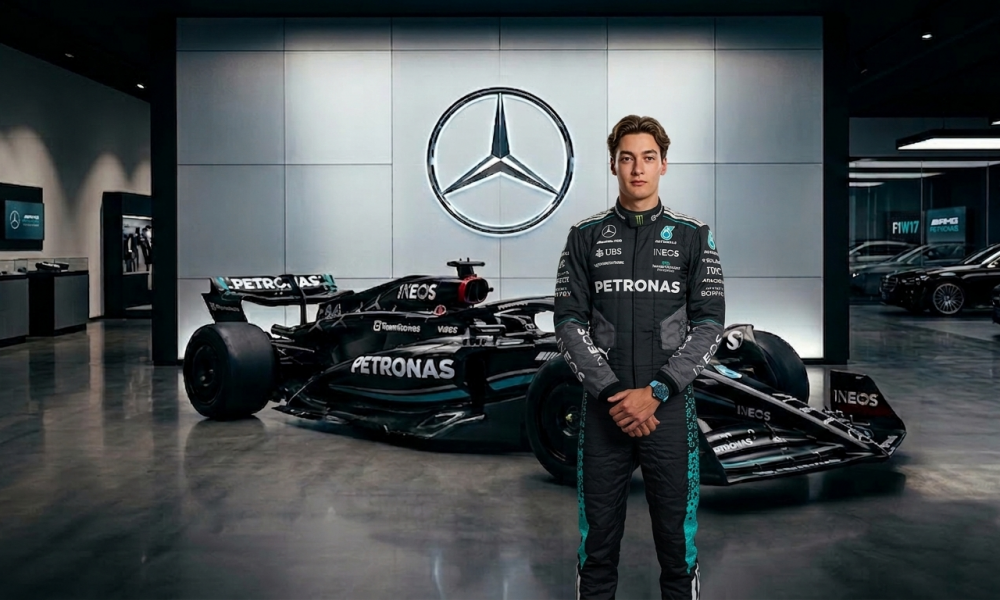
Some racing careers start with millions behind them, with manufacturer academies from the age of eight, with parents connected to the paddock. And then there are stories like George Russell’s, which begin with his father selling a seeds and pulses business to fund the karting of his youngest son, and with a sixteen-year-old preparing a homemade PowerPoint presentation to convince Mercedes to back him. That presentation, prepared when his father told him he could no longer fund his career, was the turning point. Mercedes said yes. And the rest, as they say, is history.
George William Russell was born on February 15 1998 in King’s Lynn, Norfolk, a town of around 45,000 inhabitants in eastern England, historically known for its port and medieval trade. It is not a place associated with producing Formula 1 drivers. He grew up in Tydd St Giles and Castle Rising, small county villages, the youngest of three siblings. His brother Benjy was the one who introduced him to karting as a child, simply because the family spent time at circuits watching Benjy compete. When George first got into a kart at seven years old, it was clear from the first laps that this was not a hobby but a vocation.
The number 63 he carries on his Formula 1 car has a story not everyone knows: it comes from the kart number his brother used to rent when they were young. It is the kind of detail that says everything about Russell’s character, a driver who carries his personal history marked in the details of the car.
Karting: building the foundations
Russell began competing formally in karts in 2006 and progressed with a speed that soon attracted attention beyond the local level. In 2009 he won the Super One National Cadet Championship. In 2010 he added the Super One British Championship and the British Formula Kart Starts Series. In 2011 and 2012 he won consecutively the CIK-FIA European Championship in the KF3 class, one of the most prestigious karting competitions in the world. In 2013, his final karting year, he finished nineteenth in the KF1 CIK-FIA World Championship. It was time to move to single-seaters.
2014-2016: The single-seater ladder and the first Mercedes contact
In 2014 Russell made his single-seater debut in the Formula Renault 2.0 Alps Championship with Koiranen GP, finishing fourth with one podium at the Red Bull Ring. He also competed in the BRDC Formula 4 Championship with Lanan Racing, winning it by just three points over teammate Arjun Maini with pole and victory in the season’s final race. With that triumph came something else: the McLaren Autosport BRDC Award, presented to the best young British driver. Russell became the youngest ever winner of that award at just 16, beating a certain Alex Albon.
That same year he had his first Formula 1 test sessions with Force India in Brazil and Abu Dhabi. In 2015 he moved to European Formula 3 with Carlin, where his first season in a high-level European category ended sixth with victories, finishing as the second-best rookie behind Leclerc. In 2016 with Hitech GP he was third in the championship with two victories including one at the mythical Circuit de Pau.
The defining moment came in January 2017. Mercedes, which had observed his progression with growing attention, brought him into their junior programme. He was 18 years old. And there is a detail that reveals everything about Russell’s character: when the moment came to interest Mercedes in him, with his father unable to keep funding his career, Russell prepared a PowerPoint presentation with statistics, comparisons with other drivers and arguments about his potential. He went directly to the team and presented it. Mercedes was convinced. Russell recalled it years later with humour: other F1 teams spoke to me before Mercedes and it felt like they didn’t even care. Because in this time, junior programmes were not a thing. I think McLaren had one driver, Mercedes had one, Ferrari had maybe Jules Bianchi but he was already in F1. And Red Bull had maybe five or six. So I just thought I need to do something that will be memorable.
2017: GP3 and the first elite junior title
With Mercedes behind him and ART Grand Prix as his team, Russell dominated the 2017 GP3 championship. Four victories, seven podiums, title with two races to spare. It was his rookie year in the category. Once again the same pattern: he arrives at a new category and wins it first time.
2018: The Formula 2 championship and the F1 ticket
The 2018 Formula 2 grid was considered possibly the strongest in the previous decade: Lando Norris, Alex Albon, Nyck de Vries, Nicholas Latifi. Russell with ART Grand Prix won the championship in his rookie year, becoming only the fifth driver in history to win the then GP2/F2 in their first season. He won seven races in twenty-four and finished with 86 points of advantage over Norris. Mercedes had named him their team reserve driver during that season. The 2018 season ended with a Williams seat for 2019.
2019-2021: Williams and three years of school
Three seasons at Williams. Three seasons with a car that was consistently the penultimate or last on the grid. And yet Russell extracted from those years something that no podium could have given him: the reputation of being the best driver in the world at extracting performance from an inferior car, the honorary title of doing a champion’s work with a minimum-budget team car. He qualified ahead of his more experienced teammates each year, in conditions that were often humiliating for the car.
The moment that changed everything came in December 2020. Lewis Hamilton contracted COVID-19 before the Bahrain Grand Prix. Mercedes called Russell to substitute. It was his chance. He qualified just 0.026 seconds from Valtteri Bottas’s pole. In the race he passed Bottas on track. A pit stop error with the wrong tyres fitted, then a puncture, frustrated the victory. But he finished tenth, set the fastest lap and the entire paddock had seen what Russell was capable of.
In 2021, his final year at Williams, he claimed his first podium in the controversial Belgian Grand Prix, partially completed under safety car and recorded as the shortest Formula 1 race in modern history.
2022-2025: Mercedes and the path toward the elite
In 2022 Russell made the transition to Mercedes, replacing Valtteri Bottas alongside Lewis Hamilton. In his first season with the team he won his first Formula 1 race at the Brazilian Grand Prix in São Paulo. 2023 was difficult for Mercedes generally. In 2024 he won the Austrian Grand Prix and had a two-victory season, though with the controversial disqualification in Belgium that stands in the records as the first driver in 30 years to be disqualified from a race win. In 2025 with young Antonelli as teammate, Russell continued accumulating podiums and two victories, with Mercedes still behind the dominant McLaren of Norris.
And then came 2026. The new regulations. The era Mercedes had been preparing for years.
2026: The era Mercedes built and Russell leads
The 2026 Formula 1 regulations changed everything. The new cars, smaller and lighter, with a 50-50 power split between the combustion engine and the electrical system, were designed for an era where Mercedes had clear advantages through their power unit work. The result was immediate: pole in Australia, Russell victory in Australia, Antonelli victory in China, Antonelli pole and victory in Japan. Mercedes won the first three races of the new era.
Russell won in Melbourne the first race of the year. He qualified eight tenths ahead of the entire field. In China he was fourth. In Japan he was fourth too, victim of a rare power unit glitch that cost him the podium when he was running second behind Piastri. A virtual safety car at the wrong moment changed the race and gave Antonelli the victory while Russell dropped to fourth.
After three rounds Russell has 63 points in the championship, second behind Antonelli on 72. The internal Mercedes battle in 2026 is the most interesting secondary story in the championship: the veteran with experience and the youngster with speed. Helmut Marko already publicly warned that this tension could be the biggest threat to Mercedes’ dominance.
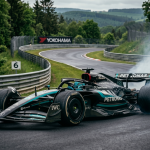
Russell publicly acknowledged in 2026, from the Nürburgring Pirelli test, that the team’s only real weak point is race starts. They are working on it in the simulator. Miami on May 1-3 is the next test. And with six Formula 1 victories, eight poles and 26 podiums accumulated up to the 2026 Japanese Grand Prix, Russell is 28 years old with every tool at his disposal to fight for his first world championship in the year he has waited for longest.
Key quotes and curiosities
Russell recalling how he secured Mercedes backing: other F1 teams spoke to me before Mercedes and it felt like they didn’t even care. I thought I needed to do something memorable. So I prepared a PowerPoint presentation for Mercedes.
Russell on the starts problem at the Nürburgring test April 2026: we are working a lot behind the scenes, analysing the data. Our sport is difficult because you do not get to practice that much. We have some ideas of why we have been falling short at race starts and hopefully we can build on that.
Russell on how he feels in 2026: I feel in a really strong place, mentally I feel the strongest I have ever been.
Among the curiosities: Russell is the only driver in the current F1 paddock whose race number, 63, has an origin directly linked to his older brother and not to any personal choice. His father Steve sold a seeds and pulses business to fund his son’s career, investing approximately 1.5 million pounds sterling across the junior years. And Russell was disqualified from his Belgian Grand Prix 2024 victory for a technical infringement, becoming the first driver in 30 years to suffer that circumstance after crossing the finish line first.
Sources: Wikipedia George Russell English, Formula1.com official, Mercedes AMG F1 Team official mercedesamgf1.com, RacingNews365, Planet F1, AutoHebdo, Formula One History, Motorsport.com
No Comment! Be the first one.