




What F1 Drivers Are Demanding From the FIA and What Could Happen Today
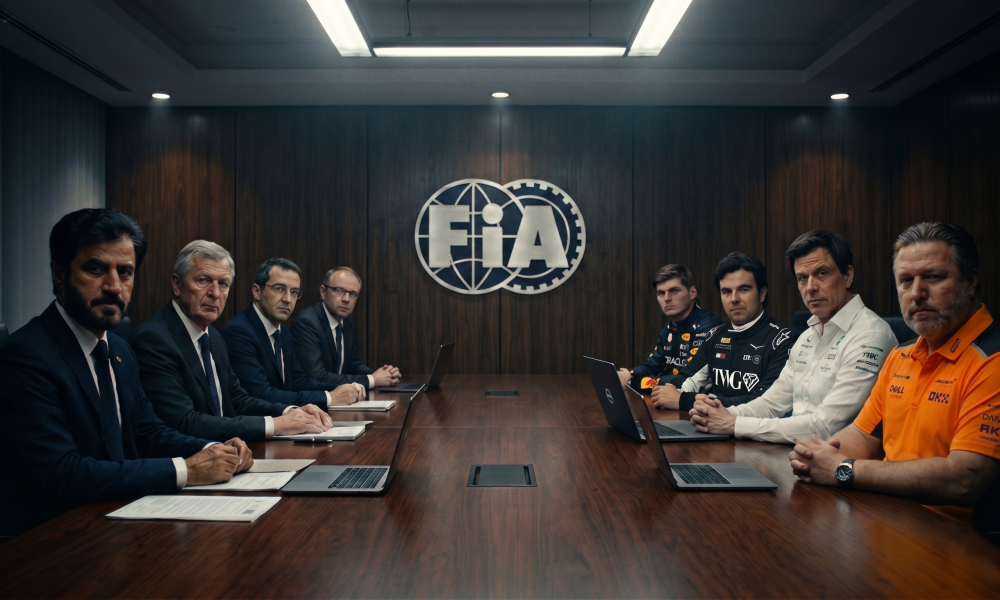
Formula 1 has a date with its own future today, April 20, 2026. While the streets of Long Beach still echo with the sound of IndyCars and Imola’s asphalt still carries the scent of the WEC weekend, the most important boardroom in world motorsport is filled with team principals, technical directors, power unit manufacturer executives, and the senior figures of the FIA and Formula One Management. The objective: to decide whether the most radical set of regulations the premier class has seen in decades requires urgent corrections before the Miami Grand Prix on May 3.
To understand the weight of what is happening today, it is necessary to go back to the beginning of the season. The 2026 technical regulations introduced seismic changes: power units with a 50-50 split between the internal combustion engine and electrical energy, active aerodynamics featuring moveable front and rear wings, and an entirely new energy management system. In theory, the purpose was magnificent: more agile cars, more sustainable, more equitable and more spectacular.
The reality on track has been more complex. Three Grands Prix Australia, China and Japan have given the FIA and the teams sufficient information to identify serious problems. The primary issue is energy management and the phenomenon the paddock now calls super clipping: cars literally decelerate at the end of straights while the drivers are flat on the throttle, because the battery has been drained and the engine must recharge it even when the driver is demanding maximum power. The result is behaviour that drivers describe as unnatural and that fans experience as a strange, incoherent spectacle.
Oliver Bearman’s accident at the Japanese Grand Prix in Suzuka transformed what had been a technical debate into a safety emergency. The young British Haas driver found himself surprised by Franco Colapinto in his Alpine, which was travelling approximately 50 km/h slower because it was in energy recovery mode. Bearman was forced off the racing line to avoid a collision, his car hit the gravel and he ended up in the barriers in a 50G impact. The drivers’ warnings about the dangerous closing speed differentials generated by energy deployment modes had become reality in the worst possible way.
Carlos Sainz, director of the Grand Prix Drivers’ Association, was the most direct in identifying the problem after the Japanese race. The Spanish driver stated that as a GPDA they had warned the FIA about what could happen and that the result had been an unfortunate consequence of speed differentials never seen before in Formula 1 until this regulation. Sainz also revealed that the FIA, through single-seater director Nikolas Tombazis, had committed to implementing changes before the Miami Grand Prix.
Max Verstappen has been the most critical voice across the entire grid. The four-time world champion, currently racing with Red Bull Racing, has spent weeks dropping hints that he is seriously considering walking away from the sport if the regulations do not change substantially. He has described 2026 F1 as “Formula E on steroids” and suggested that preparing on the simulator no longer makes sense when the cars function more as algorithms than as racing machines. Dutch media reported that Verstappen is evaluating his future with a seriousness that nobody in the paddock takes lightly.
Reigning champion Lando Norris, who until a few weeks ago had remained relatively positive about the new regulations, also added his voice to the criticism following a Pirelli tyre test at the Nürburgring this week. The McLaren driver described a moment in racing where he unintentionally drained the battery while trying to attack, leaving him as a sitting target on the following straight. Norris said he had enjoyed productive conversations with the FIA on the subject and was confident something would happen before Miami, but made it clear that the current level of driver control over the car is too limited for his taste.
George Russell, the Mercedes driver who leads the championship after winning in Australia, was even more specific about the possible solutions. In conversations with journalists this week, he pointed to increasing the super clipping harvesting limit from the current 250kW to 350kW as an obvious move. He explained that with the current limit, drivers are forced to lift and coast because the charging process is not completed in time on short straights something that can be fixed with that single adjustment without overhauling the general philosophy of the regulations. “There is a lot of low-hanging fruit,” Russell said, in a phrase that neatly captures the mood in the paddock: nobody is asking for the regulations to be scrapped, but everyone wants that fruit picked before the problem worsens.
Lewis Hamilton, the Ferrari driver who arrived at Maranello this year after ending his Mercedes stint, is the dissenting voice. The seven-time world champion has said on multiple occasions that the new rules offer the best racing he has experienced in his entire career. But even Hamilton has clarified that the safety issues related to closing speed differentials cannot be ignored and that he expects the FIA to act accordingly.
The process that has led to today’s meeting has been meticulously structured. On April 9, the FIA held the first meeting with the technical directors of all teams and the power unit manufacturers Mercedes, Ferrari, Red Bull Ford, Audi and Honda. No concrete decisions emerged from that session, but a shared diagnosis did: the energy management problem needs correction, there is generalised commitment to making adjustments, and safety is a non-negotiable priority.
On April 15, a Sporting Regulations meeting discussed the changes required in the technical area. On April 16, a new technical session deepened the analysis of proposals discussed on the 9th. And in the intervening days, the drivers met directly with the FIA in two separate sessions, after which Mohammed Ben Sulayem, the federation’s president, described the feedback received from drivers as “invaluable” and noted that there had been “constructive and collaborative dialogue” on the necessary adjustments, particularly in the area of energy management.
The two key changes debated most extensively across all these meetings are as follows. The first is raising the energy recovery limit during super clipping from the current 250kW to 350kW, equalling the ceiling available during lift and coast. This change would make super clipping the preferred option for drivers, dramatically reducing the frequency of the lifting and coasting behaviour that feels so unnatural. The second debate concerns the qualifying recharge limit per lap, currently set at nine megajoules. Reducing that figure would mean drivers have less energy to manage on a qualifying lap, bringing the experience closer to the flat-out laps that have defined historic F1.
There is also a more fundamental proposal under discussion: reducing the maximum electrical energy deployment rate to extend the battery package’s longevity across a lap. This is the most conservative solution and the one that least affects the DNA of the new regulations, but it also has the most support among manufacturers because it does not compromise the sustainability and efficiency message that gave birth to the new rules in the first place.
Andrea Stella, McLaren’s team principal and one of the most respected engineers in the paddock, articulated the spirit in which the teams are entering today’s meeting. He stated that there is a sense of responsibility and collaborative spirit among the participants in these conversations. Stella highlighted that the technical relationship with the FIA is at one of its most positive points in many years a signal that the parties are willing to find solutions without litigation or obstruction.
What today’s meeting is expected to produce is a vote by the teams, the FIA, Formula One Management and the power unit manufacturers on a concrete package of changes that will then need to be ratified by the FIA’s World Motor Sport Council through an electronic vote. The process, though formal, is in practice a ratification of what the technical parties have already agreed. The approved changes would come into force before the Miami Grand Prix.
The political context is unavoidable. The 2026 season has begun with two Grands Prix cancelled Bahrain and Saudi Arabia as a consequence of the conflict in Iran that has disrupted the calendar. That enforced five-week gap between the Japanese Grand Prix and Miami provided exactly the window the FIA needed to act. Without that gap in the calendar, implementing technically verified and tested changes between races would have been far more difficult.
There is also the shadow of Verstappen. Whether his words represent public negotiation or genuine conviction, the fact that the most dominant driver of the previous generation is questioning his future is an image problem no one in Formula 1 can afford to ignore. His presence or absence on the grid in coming years depends in part on what happens in that boardroom today.
What is already clear, hours before the results of this decisive meeting are known, is that Formula 1 in 2026 is at a genuine inflection point. The sport has all the tools to correct its course: political will, technical data, driver pressure and the urgency of safety. The question everyone in the paddock is asking today is not whether there will be changes, but how many and how deep they will go.
Do you think the changes the FIA approves today will be enough to reignite the passion of drivers like Verstappen for Formula 1, or are more radical modifications needed to save the new 2026 regulatory framework?
KEY STATEMENTS FROM DRIVERS AND ENGINEERS
MAX VERSTAPPEN (Red Bull Racing): Has spent weeks describing F1 2026 as “Formula E on steroids.” He has suggested he does not enjoy driving the new cars, and Dutch media reported he is “seriously considering” retiring from the sport.
GEORGE RUSSELL (Mercedes): Stated this week that raising the super clipping limit from 250 kW to 350 kW is “a no-brainer.” He pointed out there is “a lot of low-hanging fruit” in the form of simple changes that would massively improve the driving experience.
LANDO NORRIS (McLaren) — Reigning Champion: Voiced his criticism following this week’s Nürburgring test. He described how he can unintentionally run out of energy while attacking, leaving him as a sitting duck on the following straight. He expressed confidence that the FIA will act before Miami.
CARLOS SAINZ (GPDA Director): Was the most forceful voice after Bearman’s crash at Suzuka: “We have warned the FIA about what could happen, and this has been the unfortunate result of speed differentials never seen before in Formula 1 until these regulations.”
LEWIS HAMILTON (Ferrari): Takes the opposite position to Verstappen. He has described the 2026 regulations as the “best racing” of his career, though he acknowledges that the safety concerns must be addressed.
ANDREA STELLA (McLaren, Team Principal): Highlighted the “sense of responsibility and spirit of collaboration” among the teams ahead of today’s meeting. He noted that the technical relationship with the FIA is at a particularly positive point right now.
AYAO KOMATSU (Haas, Team Principal): Following Bearman’s accident, declared that “we simply cannot ignore it,” referring to the closing speed differentials between cars in different states of battery charge.
MOHAMMED BEN SULAYEM (FIA President): Described the driver feedback as “invaluable” on Sunday, April 19, one day before the decisive meeting. Confirmed that there is “constructive and collaborative dialogue” between the drivers and the FIA.
Sources: FIA Official fia.com, Motorsport Week motorsportweek.com, Planet F1 planetf1.com, GP Fans gpfans.com, Sky Sports F1 skysports.com, ESPN espn.com, GP Blog gpblog.com, The Race the-race.com, Sport Snaut sportsnaut.com, Wikipedia en.wikipedia.org

No Comment! Be the first one.