





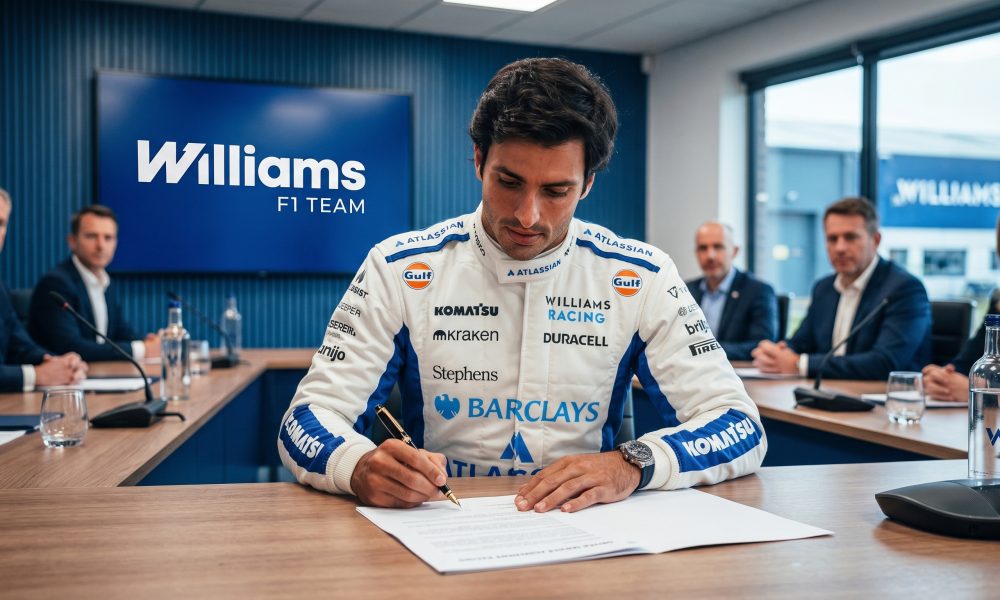
Some renewals are just paperwork. Others are a statement of principle. This one belongs to the second group. Carlos Sainz had already lost his Ferrari seat to Lewis Hamilton, had interest on the table from Audi, the same project he had spoken with before signing for Williams, and from an Aston Martin that could use a big name. With all of that on the table, he chose to stay at a team currently sitting ninth out of eleven, with just 11 points after eleven races. Williams confirmed the extension this Wednesday, ahead of the Dutch Grand Prix, one day after announcing the same deal with Alex Albon.
Table Of Content
We had been following this story since the summer break began, when Sainz himself said he would decide his future during the layoff. This wasn’t a rushed call. By every account, it was a decision made with time and care, which is exactly what makes it worth paying attention to.
A 2026 That Hasn’t Helped At All
Let’s be honest about the numbers, there’s no room to dress this up. The Williams FW48 arrived to preseason overweight, missed the Barcelona shakedown, and started the year nowhere near the fight. Sainz sits 15th in the drivers’ championship with just six points through eleven races, a long way from the ninth place finish he closed out 2025 with. It is, without exaggeration, one of the roughest starts of his career in eleven seasons in F1.
And yet, inside that grey picture, Sainz remains the team’s benchmark. He holds a 9-2 qualifying advantage over Albon, with an average gap of roughly three tenths. In 2025, his first season at Williams, he delivered the team’s best result since 2016 or 2017, depending on the source, with a podium in Baku, a sprint podium in Austin, and another podium in Qatar. He was, in practice, the driver who gave Williams back the feeling of fighting for something real after years of anonymity in the midfield.
What Each Side Said
James Vowles didn’t waste words on what keeping Sainz means. He said that from the moment he joined, his talent behind the wheel and his dedication back at the factory had been extremely valuable to the project, working day in and day out with the engineers to find every millisecond. He called him a leader of the team, not just a fast driver, and added that Sainz shares the belief and ambition they have at Atlassian Williams, pushing every day to deliver it.
Sainz, for his part, was the more direct of the two. He said he was thrilled to continue his journey with the Atlassian Williams family, that he firmly believes in the people who make up the team, both at the factory and at the racetrack, and in the investment and work happening behind the scenes. He closed with a line that sums up the whole announcement well: we have what it takes to turn this around together, I’m as committed as day one to helping get Williams back where it belongs.
On the exact length of the deal, Williams gave no numbers. The team described it as a “multi-year” agreement without specifying years, though some outlets closely tracking the driver market placed the extension around 2028. What every source agrees on is that Sainz is now locked in beyond 2027.
Why Turning Down Audi Actually Makes Sense
Worth pausing here, because on the surface this looks like an odd call. Why choose to stay at a team sitting ninth over joining a fresh project like Audi, entering F1 with all the ambition of a manufacturer building something from scratch? The answer has more than one layer.
First, the top seats are locked down. Red Bull has Verstappen through 2030 and Hadjar alongside him. Ferrari has Hamilton and Leclerc on long deals. Mercedes isn’t touching Russell or Antonelli. McLaren isn’t moving Norris or Piastri either. There simply wasn’t a top team seat waiting for Sainz in 2027.
Second, and this is what matters most to us, Sainz already knows what it’s like to walk into a brand new project with zero guarantees. Audi is starting from zero, with all the uncertainty that comes with any team’s first years. Williams, by contrast, is a project he already knows, one that has been improving season after season under Vowles, where he has already built real leadership with the engineering group. At 31, with four Grand Prix wins on his record, Sainz appears to have chosen to bet on the known over the promise of another badge.
What This Means For Williams
With Albon extended a day earlier and now Sainz locked in too, Williams has its full 2027 driver lineup sorted, something very few teams on the grid can claim at this point in the calendar. For a team celebrating its 50th anniversary in 2027, and coming off its best Constructors’ Championship result in nearly a decade, keeping the pairing that knows the current project best is the most logical move Vowles could make.
That leaves the bigger question, the one we keep coming back to at SpeedRace F1 every time Williams comes up this year: is continuity and faith enough to turn around a season this bad? Sainz already gave his answer by re-signing. What do you think, smart bet or lack of options dressed up as loyalty?
Sources: ESPN, Formula1.com, beIN Sports, The Race, RacingNews365, PlanetF1, Frontstretch, Speedweek, Japan Times.




No Comment! Be the first one.