



The End of an Era? Everything We Know About the Technical Revolution Reshaping Red Bull From Within
No Newey, No Wheatley: The Silent Technical Revolution Redefining Red Bull Racing Some teams dominate motorsport through sheer financial brute force. Others do it through the brilliance of a handful...

No Newey, No Wheatley: The Silent Technical Revolution Redefining Red Bull Racing
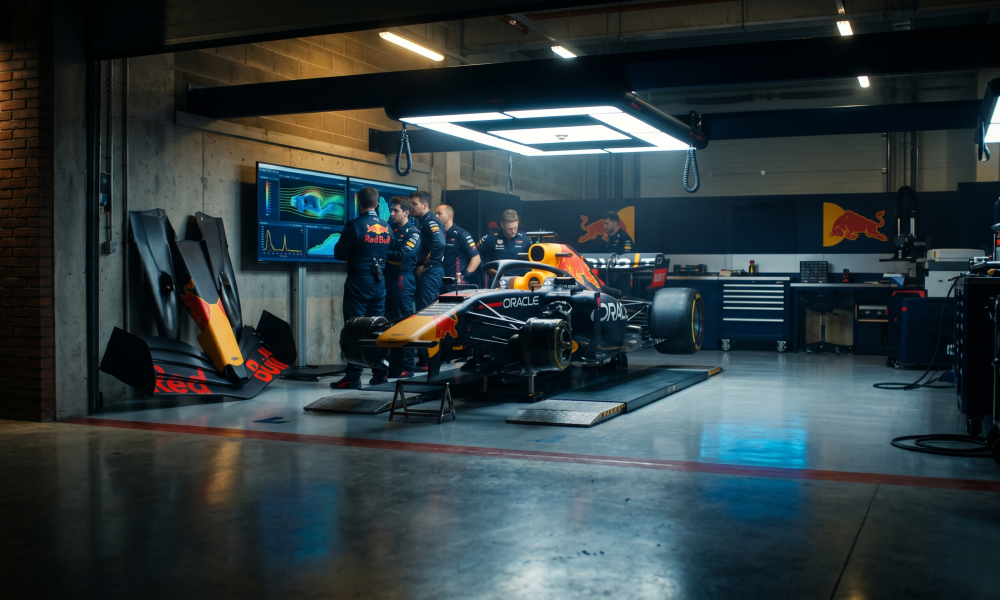
Some teams dominate motorsport through sheer financial brute force. Others do it through the brilliance of a handful of exceptional minds. Red Bull Racing, for almost two decades, managed to be both at the same time. But since May 2024, the Milton Keynes outfit has been going through one of the deepest and most turbulent technical restructuring processes Formula 1 has seen in years. A reorganization that was not chosen but forced by the departure of its two most influential figures, and which, as of April 2026, continues unfolding with fresh moves.
To understand the weight of what happened, you have to go back to the beginning.
The Newey Era: When Red Bull Became a Winning Machine
Adrian Newey arrived at Red Bull Racing in 2006 from McLaren, where he had already proven that his aerodynamically singular vision could transform teams into champions. At Milton Keynes, that transformation reached historical proportions. Under his leadership as Chief Technical Officer, the team won four consecutive Constructors’ and Drivers’ World Championships between 2010 and 2013 with Sebastian Vettel. Then came the second dynasty: the 2021, 2022, and 2023 titles with Max Verstappen at the wheel. Seven drivers’ titles, six constructors’ titles, 118 victories and 101 poles through the 2024 Chinese Grand Prix. Numbers that, if written on a wall, would fill an entire facade.
But empires also crack from within.
The Fracture: Scandals, Tensions, and the First Great Departure
2024 began with turbulence that had nothing to do with the racetrack. Allegations of inappropriate conduct against team principal Christian Horner in the early months of the season placed the team under unprecedented institutional pressure. Although Horner was cleared following an internal investigation, the atmosphere inside the garage was no longer the same. According to reports from the German outlet Auto Motor und Sport, that internal conflict was one of the factors that led Newey to decide to leave a house he had built brick by brick.
On May 1, 2024, during the Miami Grand Prix weekend, Red Bull Racing made official what had already become an open secret: Adrian Newey would leave the team in the first quarter of 2025. In his farewell statement, the engineer acknowledged nearly two decades of work with a phrase that left little room for interpretation: “I feel now is an opportune moment to hand that baton over to others and to seek new challenges for myself.” He subsequently confirmed his destination: Aston Martin, which he joined in March 2025 as Managing Technical Partner, with a mandate to build the 2026 car from scratch under the new regulations.
The decision had immediate consequences on track. The 2024 Chinese Grand Prix in April was the last time Sergio Perez managed a podium finish for the entire season. From that point forward, with Newey progressively stepping back from the development of the RB20, the car began showing growing inconsistency that not even Verstappen’s extraordinary talent could fully mask. Newey himself later admitted in an interview with Auto Motor und Sport that he had noticed warning signs since late 2023, but that the organization had not paid sufficient attention at the time.
The Second Wave: Jonathan Wheatley Ships Out
If Newey’s departure was a technical blow, the exit of Jonathan Wheatley just three months later was an operational blow of equal magnitude. On August 1, 2024, Red Bull announced that their Sporting Director, a pillar of the team for 18 years and the man responsible for maintaining arguably the best pit crew in Formula 1, was leaving to become Team Principal of Sauber, set to transform into Audi’s factory operation in 2026. Wheatley, who had joined Red Bull in 2006 from Renault where he was chief mechanic, became one of the most efficient race-day managers the paddock has ever seen. His farewell statement was brief but loaded: “I am extremely proud to have been a part of the Red Bull Racing journey over the last 18 years and will leave with many fond memories.”
Horner attempted to defuse the situation with a phrase that summarized the official position: “Rebuild would be overstating it for two people leaving. It’s evolution.” But in the paddock, few were buying that reading easily. Losing the technical brain and the sporting operator within the same year represented, for many analysts, the end of an era built on the perfect complementarity between design, execution, and management.
The Response: Internal Structure and New Leaderships
Red Bull did not wait for the wounds to deepen. Before the summer of 2024 was out, the team began assembling a new structure based on internal promotion. Pierre Waché, until then second in the technical hierarchy and one of Newey’s closest disciples, assumed the role of Technical Director with full authority. Enrico Balbo took charge of aerodynamics, the division that had always been the heart of Red Bull’s dominance. Gianpiero Lambiase, the race engineer who for years had been Verstappen’s voice on the radio and one of the best technical communicators in the paddock, was promoted to Head of Races reporting directly to Waché. Richard Wolverson became Head of Race Operations. Stephen Knowles was elevated to Director of Sporting Regulations.
Christian Horner put it with genuine enthusiasm: “For me especially it’s rewarding to promote people here. We have a lot of talented people and I’m happy to give them the opportunity to shine.”
The team also released Wheatley earlier than originally agreed. Although the Sporting Director was contracted to stay until July 2025, Red Bull agreed to free him from April 1, allowing him to make his debut on the Sauber pit wall at the 2025 Japanese Grand Prix.
The RB21: The First Post-Newey Red Bull
The RB21, unveiled on February 25, 2025, entered history for a detail that in any other context might have seemed minor: it was the first Red Bull since the RB2 not to carry Newey’s signature in its design. Pierre Waché took the reins with a philosophy clearly distinct from that of his predecessor. While Newey always bet on maximum absolute performance even if that meant a harder car to drive, Waché prioritized expanding the car’s operating window, making it more predictable, more driver-friendly, and less dependent on perfect conditions.
The aerodynamics department under Enrico Balbo carried out meticulous evaluation work: studying how much of the RB20 concept could serve as a base for the RB21 and what had to be discarded entirely. The conclusion was that the internal airflow dynamics needed to be simplified, reverting to a more traditional baseline compared to the RB20, which at the time had surprised the world with concepts radically different from the dominant RB19 of 2023.
The 2025 season started with difficulties. Verstappen openly admitted the RB21 did not begin at the expected level and that the team took too long to understand the car’s real operating window. But the recovery came. After the summer break, Red Bull found the right direction and closed the season strongly, extending the development of the RB21 further than most rivals. Laurent Mekies, director of Racing Bulls, captured the spirit of that turnaround well: “That gives confidence to the people. We already had confidence in our people in the sense that we think we have the best talents in the industry.”
April 2026: The Reorganization Continues
Red Bull’s technical transformation did not end with the appointments of 2024. On April 17, 2026, just hours before the Bahrain Grand Prix weekend, the Austrian outfit announced a fresh round of organizational changes in its technical department, this time with the declared aim of “reinforcing its focus on performance and innovation.”
Ben Waterhouse, a British engineer who had joined Red Bull from BMW-Sauber in 2014 and had led performance engineering since 2017, was appointed with immediate effect as Chief Performance and Design Engineer, taking “overall responsibility for vehicle design and performance” and reporting directly to Pierre Waché. Additionally, starting July 1, 2026, Italian engineer Andrea Landi will join as Head of Performance under Waterhouse’s direction. Landi arrives with a pedigree worthy of the role: former Deputy Performance Director at Ferrari and former Deputy Technical Director at VCARB, Red Bull’s sister team now known as Racing Bulls.
The team’s official statement was precise in its intent: “These changes support the team’s long-term technical ambitions and reflect its continued focus on internal talent development while attracting the best experts from across the world of motorsport.”
Evolution or Reinvention?
The question hovering over the paddock since 2024 is whether Red Bull is going through a natural evolution or a forced reinvention. The honest answer is that it is probably both things at once. In little more than a year, the team lost the most important designer in Formula 1 history and its longest-serving sporting director. These are blows that no official statement can fully minimize.
But it is equally true that the structure left standing has genuine depth. Pierre Waché has been one of the most respected technical minds in the paddock for years. Enrico Balbo has earned his stripes. Ben Waterhouse and Andrea Landi represent a bet on a senior directorial layer that in the past did not need to exist because Newey filled that space entirely on his own. And the RB21’s recovery in the second half of 2025 showed the team has the diagnostic and corrective capacity to find its way when given time.
With the sweeping 2026 regulations around the corner, the new engine partnership with Ford, and the transition to an entirely new technical concept, Red Bull is building something different from what it once was. Whether that new something will be as good as what came before, only the stopwatch will tell.
FULL TIMELINE
2006: Adrian Newey and Jonathan Wheatley join Red Bull Racing. 2010-2013: Red Bull wins four consecutive Constructors’ and Drivers’ Championships with Sebastian Vettel. 2021-2023: Second dominant era with Max Verstappen. Four drivers’ titles and three constructors’ titles in three seasons. February 2024: Internal investigation against Christian Horner for inappropriate conduct. The team’s internal atmosphere deteriorates. April 2024: Sergio Perez finishes on the podium at the Chinese Grand Prix. It is his last podium of the season. May 1, 2024: Red Bull officially confirms Adrian Newey’s departure, effective first quarter 2025. Pierre Waché and Enrico Balbo take on greater technical responsibility. August 1, 2024: Red Bull announces Jonathan Wheatley’s exit as Sporting Director. Destination: Team Principal of Sauber/Audi. September 2024: Red Bull restructures the race team. Gianpiero Lambiase promoted to Head of Races, Stephen Knowles to Director of Sporting Regulations, Richard Wolverson to Head of Race Operations. First quarter 2025: Newey officially leaves Red Bull and joins Aston Martin. April 1, 2025: Wheatley assumes role as Team Principal at Sauber (ahead of schedule). February 25, 2025: Official unveiling of the RB21, the first Red Bull designed without Adrian Newey. 2025 season: Difficult start for Red Bull. Strong recovery in the second half of the year. December 2025: Laurent Mekies highlights the confidence generated by the team’s technical turnaround ahead of 2026. April 17, 2026: Red Bull announces new technical changes. Ben Waterhouse appointed Chief Performance and Design Engineer with immediate effect. Andrea Landi to join as Head of Performance from July 1, 2026.
KEY QUOTES AND FACTS
“I feel now is an opportune moment to hand that baton over to others and to seek new challenges for myself.” — Adrian Newey, official farewell statement, May 2024.
“Rebuild would be overstating it for two people leaving. It’s evolution.” — Christian Horner, following Wheatley’s announcement.
“I am extremely proud to have been a part of the Red Bull Racing journey over the last 18 years.” — Jonathan Wheatley, August 2024.
“We need to fix it for this year.” — Pierre Waché, on the RB21’s limitations during pre-season testing.
“At the beginning of the season, for sure, 100%. We learned things that help us now, but the knowledge came too late.” — Max Verstappen, on the RB21’s development curve.
FACTS WORTH KNOWING: The RB21 was the first Red Bull since the RB2 not to carry Adrian Newey’s signature in its design. Newey’s reported annual salary at Red Bull was in the region of ten million pounds sterling, making him one of the highest-paid engineers in motorsport history. Jonathan Wheatley began his Formula 1 career in 1991 as a junior mechanic at Benetton, the very team where Michael Schumacher won his first two world championships. Gianpiero Lambiase was reportedly on the radar of Ferrari and McLaren before his internal promotion at Red Bull, according to Autosport. Red Bull Racing was founded in 2005 when the energy drinks company acquired the Jaguar Racing team for a reported price of one dollar. Pierre Waché joined Red Bull in 2013 after several years at Ferrari, eventually becoming one of the team’s most trusted technical pillars. Ben Waterhouse, now Chief Performance and Design Engineer, originally came to Red Bull from BMW-Sauber in 2014, the very team that Jonathan Wheatley is now leading under the Audi banner.
Is Red Bull still capable of competing at the very top without Newey’s genius, or are we watching the beginning of a more vulnerable chapter for the Bulls? Leave your take in the comments, because even inside the paddock, nobody agrees on the answer.
Sources:
Red Bull Racing official website — redbullracing.com Formula1.com — Official announcement: Jonathan Wheatley leaves Red Bull, August 1, 2024 Motorsport.com — “Adrian Newey set to leave Red Bull F1”, April 2024 Motorsport.com — “Red Bull unveils the new RB21 for Verstappen’s 2025 season”, February 2025 Motorsport.com — “Why Red Bull gave up development time for the 2026 car”, December 2025 Motorsport.com — “Was the Red Bull RB21 never as bad as everyone thought?”, October 2025 Infobae.com — “Red Bull makes changes in its technical department to reinforce its focus on performance and innovation”, April 17, 2026 grandprix.com — “Red Bull confirms Newey leaving”, May 1, 2024 Al Jazeera Sports — “F1 design guru Newey confirms 2025 exit in blow to Red Bull Racing”, May 1, 2024 f1i.com — “Red Bull sporting director Wheatley in shock exit to Audi”, August 1, 2024 Grande Prêmio ES — “Red Bull starts internal changes and promotes Verstappen’s engineer”, September 2024 Grande Prêmio ES — “Red Bull simplifies the RB21 for F1 2025”, January 2025 Auto Motor und Sport — Adrian Newey quotes on RB20 and his Red Bull departure Wikipedia — Adrian Newey, Red Bull Racing, Jonathan Wheatley entries
No Comment! Be the first one.