


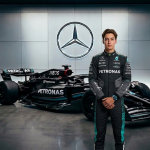
Winning every race does not mean being perfect. Mercedes knows that better than anyone. Toto Wolff’s team has dominated the first three Grands Prix of Formula 1’s 2026 era with an advantage that reached nearly eight tenths in qualifying in Australia, three and a half in China and Japan. Kimi Antonelli leads the world championship with 72 points. The W17 is the best car on the grid. And yet, in each of the three races completed, Mercedes has suffered at the most critical moment of the entire weekend: lights out.
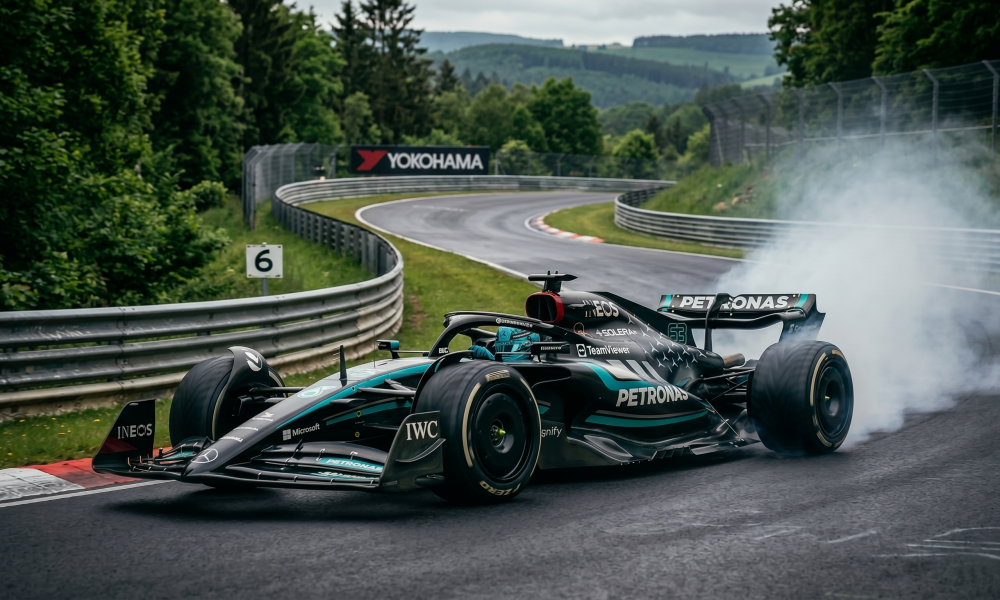
George Russell said it plainly from the Nürburgring paddock, where this week he completed 127 laps in the Pirelli tyre test: there is a huge amount going on behind the scenes. As in any sport, there is a lot that goes on that people do not see. We have this opportunity to be testing today. There are lots of days on the simulator analysing the first three races and looking ahead to the next couple that are coming up.
Mercedes’ starts problem in 2026 is no secret. It is the recurring paddock conversation every time the German team’s performance is analysed. In Australia, Antonelli started from pole and dropped to fifth at the first corner. In China, the same pattern. In Japan, both Antonelli and Russell lost positions off the line while Ferrari, with its smaller turbo that takes less time to spool up, benefited from the technical difference. Lewis Hamilton and Charles Leclerc have the best launches on the grid in 2026, an advantage that Russell himself acknowledged before the season had even begun.
But the context of Russell’s remarks this week has one important peculiarity: in a Pirelli test the regulations explicitly prohibit practising starts. It is the same rule for everyone. Russell pointed it out with precision: we are here because it is a Pirelli test and a tyre test, we are not allowed to do any starts, that is the same for any team when they do tyre testing. Of course we would love to be out there doing loads and loads of starts. It is part of the rules that you are not allowed to drive. Our sport is difficult because you do not get to practice that much.
What Mercedes can do during the break, and is in fact doing intensively according to Russell, is work in the simulator. The Brackley team has one of the most advanced simulation systems in the world, and in the weeks without races that tool becomes the main training ground. We are working a lot behind the scenes analysing the data. We have some ideas of why we have been falling short of the race starts, so hopefully we can build on that, the British driver declared.
The technical key to the problem lies in the nature of the new 2026 engines. The 2026 hybrid era power units have an approximately equal power split between the internal combustion engine and the electrical system, with the MGU-K contributing up to 350 kilowatts. At the moment of the start, controlling that electrical flow is critical: too much electrical power at once can cause wheelspin, too little leaves the car unresponsive. Ferrari appears to have found the sweet spot ahead of Mercedes. Their smaller turbo has a faster response in the initial acceleration phase, which makes finding the optimal launch window easier.
Mercedes has spent three months identifying the pattern of the problem. Already during pre-season testing in Bahrain in February, Russell admitted that the two starts he had done that week were worse than any start in his entire career. Hamilton observed from Ferrari that the Maranello team’s start advantage was a surprise to everyone. And three races later, with three victories accumulated through the W17’s raw on-track speed, the problem persists without a visible solution.
What distinguishes Mercedes’ situation from being a genuine crisis is precisely that: the car’s pace once the race is underway is so superior that even losing two or three positions at the start they are capable of recovering them. Antonelli won in China and Japan while coming to lead them with authority after poor launches. But Miami changes the equation. The Miami Grand Prix on May 1-3 is a sprint weekend. There are fewer laps, less time to recover and early mistakes carry more weight. If Mercedes has not solved the starts problem before Florida, the threat from McLaren, Ferrari and the rest becomes more real.
Russell also mentioned another detail that reveals the intensity of the work during the break: the team has another filming day scheduled later in the week. Filming days, limited to 200 kilometres with demonstration tyres, do not allow the intensive technical work of a real test, but they provide lap hours that feed the team’s analysis systems.
The Nürburgring, the circuit that has not seen Formula 1 racing since 2020 and which Russell described this week as a traditional old-school circuit, drew out of him words that go beyond tyres. When asked whether he would like to see the Nürburgring return to the calendar, Russell was direct: I would love to be back racing here one day. And of course with Mercedes it would probably be nicer to have a race back in Germany on the calendar. The most successful German team in recent Formula 1 history has no home Grand Prix. That is another conversation this test involuntarily opened.
Key quotes and curiosities
Russell from the Nürburgring on April 15 2026: there is a huge amount going on behind the scenes. As in any sport, there is a lot that goes on that people do not see. There are lots of days on the simulator analysing the first three races and looking ahead to the next couple that are coming up.
Russell on race starts: we are working a lot behind the scenes, analysing the data. Our sport is difficult because you do not get to practice that much. We have some ideas of why we have been falling short at race starts and hopefully we can build on that.
Russell on the starts problem during pre-season Bahrain testing: the two starts I made this week were worse than my worst ever start in Formula 1.
Among the curiosities worth noting: Mercedes has won all three opening races of 2026 but in none of them did either Antonelli or Russell lead the first lap. They are the only team in recent Formula 1 history to win three races without ever leading the opening tour of any of them. And the Nürburgring, backdrop to these declarations, has not hosted a Formula 1 Grand Prix since Hamilton won there in October 2020, the same race in which the Englishman equalled Michael Schumacher’s record of 91 victories.
Sources: Sky Sports F1, Crash.net, Speedcafe, GPBlog, The Judge 13, Motorsport.com, RacingNews365, PlanetF1
No Comment! Be the first one.