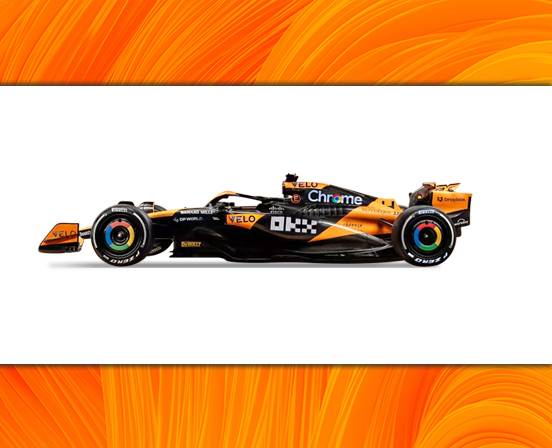
McLaren is a historic F1 team, renowned for its numerous championships and legendary drivers such as Ayrton Senna and Lewis Hamilton. Over the years, it has stood out for its technological innovation and competitiveness.
1 TH PLACE
584 PTS
TEAM
BASE
TEAM CHIEF
TECHNICAL CHIEF
CHASSIS
POWER UNIT
FIRST TEAM ENTRY
WORLD CHAMPIONSHIPS
POINTS
HIGHTEST RACE FINISH
PODIUMS
POLE POSITIONS
FASTEST LAPS
McLaren Formula 1 Team
Woking, United Kingdom
Andrea Stella
Peter Prodromou / Neil Houldey
MCL39
Mercedes
1966
9
7534.5
1 (x201)
438
173
187
1963
Bruce McLaren, a New Zealand driver and designer, founds the McLaren team based in Woking, Surrey, UK, with the goal of competing in the Tasman Series races in New Zealand and Australia. McLaren's first car, the M1A, was presented in November of that year.
1966
McLaren makes its Formula 1 debut at the Monaco Grand Prix with Bruce McLaren and Chris Amon behind the wheel of the M2B, which featured a Ford-sourced 3-litre V8 engine. McLaren's season was not successful, and the only time they managed to finish in the points was at the United States Grand Prix, where Bruce McLaren finished in sixth place.
1967
McLaren presented the M4B, a more evolved car, with a tubular steel structure and an aluminum body, which led Bruce McLaren to get McLaren's first podium finish in Formula 1 at the Monaco Grand Prix, finishing in third place.
1968
McLaren takes its first victory in Formula 1 at the Belgian Grand Prix, with Bruce McLaren at the wheel of the M7A, a car that featured an aluminum monocoque chassis. That year, the team finished in third place in the Constructors' Championship.
1969
McLaren introduces the M9A, a car that featured an innovative "brick nose" and became one of the most recognizable cars of the era. However, the season was not as successful as the previous one, and McLaren managed only one podium finish, with Bruce McLaren taking third place at the Monaco Grand Prix.
1970
Denny Hulme, who joined McLaren in 1968, wins the Formula 1 World Drivers' Championship, becoming the first driver to win a world championship with McLaren. McLaren also wins the Constructors' Championship.
1971
McLaren presents the M19A, a car that featured an aluminum monocoque chassis and a Ford Cosworth V8 engine. The season was not as successful as the previous one, and McLaren managed only one podium finish, with Denny Hulme in second place at the Spanish Grand Prix.
1972
McLaren introduces the M19C, an improved version of the M19A, but the season was not a successful one for the team, which only managed one podium finish, with Peter Revson taking third place at the British Grand Prix.
1973
McLaren presents the M23, a car that featured an aluminum monocoque chassis and a Ford Cosworth V8 engine, and which became one of the most successful cars in Formula 1 history. The season was a very successful one for McLaren, with Peter Revson and Denny Hulme taking two wins each and the team finishing second in the Constructors' Championship.
1974
Emerson Fittipaldi joins McLaren and wins the Formula 1 World Drivers' Championship with the M23. McLaren also wins the Constructors' Championship for the second time.
1975
McLaren introduces the M23B, an improved version of the M23, but the season was not successful for the team, which only managed one victory, with Emerson Fittipaldi at the British Grand Prix.
1976
James Hunt joins McLaren and wins the Formula 1 World Drivers' Championship in the M23. The season was very exciting, with an intense rivalry between Hunt and Ferrari's Niki Lauda. McLaren also wins the Constructors' Championship for the third time.
1977
McLaren introduces the M26, powered by a Ford Cosworth V8 engine. The season was less successful than the previous one, with McLaren only taking one win, with James Hunt at the Japanese Grand Prix.
1978
McLaren presents the M28, a car that featured an aluminum monocoque chassis and a Cosworth DFV V8 engine. The season was very difficult for the team, which only achieved one podium, with Patrick Tambay in third place at the United States Grand Prix.
1979
McLaren introduces the M28B, an improved version of the M28, but the season was not a successful one for the team, which only managed one podium finish, with John Watson taking third place at the British Grand Prix.
1980
McLaren presents the M29, a car that featured an aluminum monocoque chassis and a Cosworth DFV V8 engine. The season was more successful than the previous one, with John Watson and Alain Prost achieving two victories each and the team finishing third in the Constructors' Championship.
1981
McLaren presents the MP4/1, the first Formula 1 car built entirely in carbon fiber. The season was difficult for the team, which only achieved one podium finish, with John Watson in second place in the Spanish Grand Prix.
1982
McLaren introduces the MP4/1B, an improved version of the MP4/1, but the season was not a successful one for the team, which only managed one podium finish, with Niki Lauda taking second place at the British Grand Prix. p>
1983
Niki Lauda retires from Formula 1 and is replaced by John Watson. McLaren introduces the MP4/1E, an evolved version of the MP4/1, and the season was very successful for the team, with John Watson and Niki Lauda achieving three victories each and the team winning the Constructors' Championship.
1984
McLaren presents the MP4/2, a car that featured a carbon fiber monocoque chassis and a turbocharged TAG-Porsche V6 engine. The season was incredibly successful for the team, with Niki Lauda and Alain Prost achieving 12 wins in total and the team winning the Constructors' Championship for the second time in a row.
1985
McLaren introduces the MP4/2B, an improved version of the MP4/2, and the season was equally successful for the team, with Alain Prost winning the Formula 1 World Drivers' Championship and the team winning the Constructors' Championship for the third time in a row.
1986
McLaren introduces the MP4/2C, an evolved version of the MP4/2B, and the season was very exciting, with Alain Prost and Ayrton Senna battling for the Formula 1 World Drivers' Championship. In the end, Alain Prost was crowned champion and the team won the Constructors' Championship for the fourth time in a row.
1987
McLaren presents the MP4/3, a car that featured a carbon fiber monocoque chassis and a turbocharged TAG-Porsche V6 engine. The season was difficult for the team, with technical and reliability that prevented Alain Prost and Stefan Johansson from fighting for the championship. The team finished second in the Constructors' Championship.
1988
McLaren presents the MP4/4, a car that is considered one of the best in the history of Formula 1. With Ayrton Senna and Alain Prost as drivers, the team swept the season, winning 15 of the 16 races and achieving the Formula 1 World Drivers' Championship and the Constructors' Championship.
1989
McLaren presents the MP4/5, a car that featured a carbon fiber monocoque chassis and a Honda V10 engine. The season was very exciting, with Ayrton Senna and Alain Prost fighting for the Formula 1 World Drivers Championship. In the last race of the season, in Japan, Senna collided with Prost and won the championship. The team also won the Constructors' Championship.
1990
McLaren introduces the MP4/5B, an evolved version of the MP4/5, and the season was equally exciting, with Ayrton Senna and Alain Prost battling it out for the Formula 1 World Drivers' Championship. In the last race of the season, in Japan, Senna won the championship, but was disqualified for a technical offence. The team also won the Constructors' Championship.
1991
McLaren presents the MP4/6, a car that featured a Honda V12 engine. The season was very successful for the team, with Ayrton Senna winning his third Formula 1 World Drivers' Championship and the team winning the Constructors' Championship.
1992
McLaren presents the MP4/7A, a car that featured a carbon fiber monocoque chassis and a Honda V12 engine. The season was difficult for the team, which only managed three victories, with Ayrton Senna in Monaco, Hungary and Australia, and Gerhard Berger in Canada. The team finished in third place in the Constructors' Championship.
1993
McLaren presents the MP4/8, a car that featured a monocoque chassis and a Ford V8 engine. The season was difficult for the team, with Ayrton Senna fighting for the championship but ultimately finishing in second place behind Alain Prost. The team finished second in the Constructors' Championship.
1994
McLaren presents the MP4/9, with a Ford V8 engine. The season was difficult for the team, which did not achieve any victories, finishing in third place in the Constructors' Championship.
1995
McLaren presents the MP4/10, with a Mercedes V10 engine. The season was difficult for the team, which only managed one victory, with Mika Hakkinen at the European Grand Prix. The team finished in fourth place in the Constructors' Championship.
1996
McLaren presents the MP4/11. The season was difficult for the team, which only managed one victory, with Mika Hakkinen at the Australian Grand Prix. The team finished third in the Constructors' Championship.
1997
McLaren presents the MP4/12. Again a difficult season for the team, which did not achieve any victory, and finished in fourth place in the Constructors' Championship.
1998
McLaren presents the MP4/13. The season was very successful for the team, with Mika Hakkinen winning his first Formula 1 World Drivers' Championship and the team winning the Constructors' Championship.
1999
McLaren presents the MP4/14. The season of forgetting for the team, which achieved no wins, finishing in third place in the Constructors' Championship.
2000
McLaren presents the MP4/15. Not much changed from last season for the team, which only managed one win, with David Coulthard at the British Grand Prix. The team finished second in the Constructors' Championship.
2001
In this year, McLaren competed with Finnish driver Mika Häkkinen and Scottish driver David Coulthard. Häkkinen achieved two victories in the season and finished in fifth position in the championship of drivers while Coulthard took a victory and finished in third position in the drivers' championship.
2002
McLaren continued with the same drivers as in the previous year, however they did not take any wins in the season and Coulthard finished fifth in the drivers' championship while that Häkkinen announced his retirement from Formula 1. p>
2003
In this year, McLaren had the drivers David Coulthard and the German driver Kimi Räikkönen. Räikkönen took one season win and finished seventh in the drivers' championship while Coulthard finished in eighth position in the drivers' championship.
2004
McLaren kept the same drivers from the previous season and again Räikkönen took a season win and finished seventh in the drivers' championship while Coulthard he finished in fourteenth position in the drivers' championship.
2005
This year, McLaren featured drivers Juan Pablo Montoya from Colombia and Kimi Räikkönen. Räikkönen achieved seven podium finishes during the season and finished second in the drivers' championship while Montoya achieved three podiums and finished in fourth position in the drivers' championship.
2006
McLaren kept the same drivers from the previous season and again Räikkönen achieved seven podium finishes during the season and finished third in the drivers' championship while Montoya he took one win and finished eighth in the drivers' championship before leaving the team mid-season.
2007
This year, the team had Fernando Alonso and Lewis Hamilton as drivers. Hamilton took his first F1 victory at the Canadian Grand Prix. The team finished in third place in the constructors' championship.
2008
The season was marked by an intense fight between Hamilton and Felipe Massa for the drivers' championship. Finally, Hamilton won the title in the last race of the season in Brazil. McLaren was second in the constructors' championship.
2009
Hamilton and Button joined the team as drivers, replacing Heikki Kovalainen. The British team had an irregular season, obtaining only two victories, one with each driver.
2010
Team Principal Martin Whitmarsh replaced Ron Dennis. McLaren fared better, taking five wins in total and finishing second in the constructors' championship.
2011
The season went even better for McLaren, winning six races and finishing second in the constructors' championship behind Red Bull Racing.
2012
The British team won seven races, including a win at the Brazilian Grand Prix, but again finished second in the constructors' championship. Hamilton announced that he would join Mercedes for the 2013 season, being replaced by Sergio Pérez.
2013
McLaren failed to win any titles. Jenson Button joined the team in 2010 and went on to win the Australian Grand Prix that year. In 2012, the team achieved three victories with Hamilton and Button, but finished third in the constructors' championship.
2014
A very difficult season for McLaren. The team failed to win any race in these seasons and had problems with its Mercedes engine. The team finished fifth in the constructors' championship.
2015
This season, McLaren switched to Honda engines, but had a poor start to the season due to reliability issues and a lack of speed. The team finished ninth in the constructors' championship.
2016
McLaren improved this season, taking two fifth places and one sixth place in the races. The team finished sixth in the constructors' championship.
2017
The team maintained its partnership with Honda, but had another difficult season due to reliability issues and a lack of speed. McLaren finished ninth in the constructors' championship.
2018
McLaren switched to Renault engines and had a more competitive season, achieving a best five fifth places. The team finished in sixth place in the constructors' championship.
2019
McLaren had an impressive season, taking its first victory since 2012 at the Brazilian Grand Prix with Brazilian driver Carlos Sainz Jr. The team finished fourth in the constructors' championship.
2020
This season, McLaren achieved three podium finishes with Sainz and Lando Norris. The team finished in third place in the constructors' championship.
2021
McLaren had another successful season taking two wins and several podium finishes with Sainz and Norris. The team finished in third place in the constructors' championship.
2022
The current season is ongoing and has not ended yet. McLaren hopes to continue their recent success in Formula 1.
2023
In the 2023 Formula 1 season, McLaren saw a marked improvement in performance, emerging as one of the most competitive teams in the mid-season. The team started off struggling, but upgrades to the MCL60 allowed them to close the gap to the leading teams. Lando Norris and Oscar Piastri demonstrated great skill, with Norris taking several podiums and standing out as a key driver for the team. McLaren took advantage of the strengths of its chassis and a good engine evolution to improve its consistency in the race. Although they did not achieve victories, the team ended the season fighting for third place in the Constructors’ Championship, a significant jump from previous seasons. The constant development strategy and teamwork were fundamental to their progress.
2024
McLaren had a standout Formula 1 season in 2024, claiming its first Constructors’ Championship since 1998. Lando Norris took four wins and eight pole positions, finishing runner-up to Max Verstappen. Oscar Piastri also shone, taking his first win in Hungary and contributing to a total of six wins for the team. The MCL38 proved to be a competitive car, allowing McLaren to score 21 podium finishes, including a double win in Hungary. The season culminated with a win for Norris in Abu Dhabi, securing the Constructors’ title for McLaren. This success highlights the team’s resurgence under Zak Brown, positioning them as strong contenders for future championships.
| YEAR | POS. | CHASIS | ENGINE | TYRES | VIC. | POLE | V.R. | POINTS | GPS |
|---|---|---|---|---|---|---|---|---|---|
| 2025 | 1 | MCL39 | 12 | 9 | 10 | 584 | 15 | ||
| 2024 | 1 | MCL38 | 6 | 8 | 7 | 666 | 24 | ||
| 2023 | 4 | MCL60 | 0 | 0 | 3 | 302 | 22 | ||
| 2022 | 8 | MCL36 | 0 | 0 | 2 | 159 | 22 | ||
| 2021 | 4 | MCL35M | 1 | 1 | 2 | 275 | 22 | ||
| 2020 | 3 | MCL35 | 0 | 0 | 3 | 202 | 17 | ||
| 2019 | 4 | MCL34 | 0 | 0 | 0 | 145 | 21 | ||
| 2018 | 6 | MCL33 | 0 | 0 | 0 | 62 | 21 | ||
| 2017 | 9 | MCL32 | 0 | 0 | 1 | 30 | 20 | ||
| 2016 | 6 | MP4-31 | 0 | 0 | 1 | 76 | 21 | ||
| 2015 | 9 | MP4-30 | 0 | 0 | 0 | 27 | 19 | ||
| 2014 | 5 | MP4-29 | 0 | 0 | 0 | 181 | 19 | ||
| 2013 | 5 | MP4-28 | 0 | 0 | 1 | 122 | 19 | ||
| 2012 | 3 | MP4-27 | 7 | 8 | 3 | 378 | 20 | ||
| 2011 | 2 | MP4-26 | 6 | 1 | 6 | 497 | 19 | ||
| 2010 | 2 | MP4-25 | 5 | 1 | 6 | 454 | 19 | ||
| 2009 | 3 | MP4-24 | 2 | 4 | 0 | 71 | 17 | ||
| 2008 | - | MP4-23 | 6 | 8 | 3 | 151 | 18 | ||
| 2007 | 11 | MP4-22 | 8 | 8 | 5 | 0 | 17 | ||
| 2006 | 3 | MP4-21 | 0 | 3 | 3 | 110 | 18 | ||
| 2005 | 2 | MP4-20 | 10 | 7 | 12 | 182 | 19 | ||
| 2004 | 5 | MP4-19 | 1 | 1 | 2 | 69 | 18 | ||
| 2003 | 3 | MP4-17D | 2 | 2 | 3 | 142 | 16 | ||
| 2002 | 3 | MP4-17 | 1 | 0 | 2 | 65 | 17 | ||
| 2001 | 2 | MP4-16 | 4 | 2 | 6 | 102 | 17 | ||
| 2000 | 2 | MP4-15 | 7 | 7 | 12 | 152 | 17 | ||
| 2000 | 2 | MP4-15 | 7 | 7 | 12 | 152 | 17 | ||
| 1999 | 2 | MP4-14 | 7 | 11 | 9 | 124 | 16 | ||
| 1998 | 1 | MP4-13 | 9 | 12 | 9 | 156 | 16 | ||
| 1997 | 4 | MP4-12 | 3 | 1 | 2 | 63 | 17 | ||
| 1996 | 4 | MP4-11 | 0 | 0 | 0 | 49 | 16 | ||
| 1995 | 4 | MP4-10 | 0 | 0 | 0 | 30 | 17 | ||
| 1994 | 4 | MP4-9 | 0 | 0 | 0 | 42 | 16 | ||
| 1993 | 2 | MP4-8 | 5 | 1 | 1 | 84 | 16 | ||
| 1992 | 2 | MP4-7 | 5 | 1 | 3 | 99 | 16 | ||
| 1991 | 1 | MP4-6 | 8 | 10 | 4 | 139 | 16 | ||
| 1990 | 1 | MP4-5B | 6 | 12 | 5 | 121 | 16 | ||
| 1989 | 1 | MP4-5 | 10 | 15 | 8 | 141 | 16 | ||
| 1988 | 1 | MP4-4 | 15 | 15 | 10 | 199 | 16 | ||
| 1987 | 2 | MP4-3 | 3 | 0 | 2 | 76 | 16 | ||
| 1986 | 2 | MP4-2C | 4 | 2 | 2 | 96 | 16 | ||
| 1985 | 1 | MP4-2B | 6 | 2 | 6 | 90 | 16 | ||
| 1984 | 1 | MP4-2 | 12 | 3 | 8 | 143,5 | 16 | ||
| 1983 | 5 | MP4-1C | 1 | 0 | 2 | 34 | 11 | ||
| 1983 | - | MP4-1E | 0 | 0 | 0 | 0 | 4 | ||
| 1982 | 2 | MP4-1B | 4 | 0 | 2 | 69 | 15 | ||
| 1981 | 6 | M29F / MP4-1 | 1 | 0 | 1 | 28 | 15 | ||
| 1980 | 9 | M29B / M29C / M30 | 0 | 0 | 0 | 11 | 14 | ||
| 1979 | 7 | M28 / M28C / M29 | 0 | 0 | 0 | 15 | 15 | ||
| 1978 | 8 | M26 | 0 | 0 | 0 | 15 | 16 | ||
| 1977 | 3 | M23 / M26 | 3 | 6 | 3 | 60 | 17 | ||
| 1976 | 2 | M23 / M26 | 6 | 8 | 3 | 74 | 16 | ||
| 1975 | 3 | M23 | 3 | 0 | 2 | 53 | 14 | ||
| 1974 | 1 | M23 | 4 | 2 | 1 | 73 | 15 | ||
| 1973 | 3 | M19C / M19A / M23 | 3 | 1 | 3 | 58 | 15 | ||
| 1972 | 3 | M19A / M19C | 1 | 1 | 1 | 47 | 12 | ||
| 1971 | 6 | M19A / M14A / M7C | 0 | 0 | 1 | 10 | 11 | ||
| 1970 | 5 | M14A / M14D | 0 | 0 | 1 | 35 | 12 | ||
| 1970 | - | M7D / M14D | 0 | 0 | 0 | 0 | 4 | ||
| 1969 | 4 | M14A / M14D / M7C / M7D | 1 | 0 | 0 | 38 | 11 | ||
| 1968 | 2 | M7A | 3 | 0 | 0 | 49 | 11 | ||
| 1968 | 10 | M5A | 0 | 0 | 0 | 3 | 8 | ||
| 1967 | 10 | M5A / M7A | 0 | 0 | 0 | 3 | 6 | ||
| 1966 | 9 | M2B | 0 | 0 | 0 | 2 | 3 | ||
| 1966 | 10 | M2B | 0 | 0 | 0 | 1 | 1 |
| RACE | DATE | TEAM | ENGINE | PTS |
|---|---|---|---|---|
| 16 MAR | 27 | |||
| 23 MAR | 51 | |||
| 06 APR | 33 | |||
| 13 APR | 40 | |||
| 20 APR | 37 | |||
| 04 MAY | 58 | |||
| 18 MAY | 33 | |||
| 25 MAY | 40 | |||
| 01 JUN | 43 | |||
| 15 JUN | 12 | |||
| 29 JUN | 43 | |||
| 06 JUL | 43 | |||
| 27 JUL | 56 | |||
| 03 AUG | 43 | |||
| 31 AUG | 25 |