Marina Bay Street Circuit
- The circuit made history by hosting the first night race of the World Championship, held on September 28, 2008.
- The original circuit design was conceived by circuit design firm KBR Inc. and refined by circuit architect Hermann Tilke.
- Construction required a massive logistical effort, as the circuit is assembled and disassembled each year. Only the pit building and paddock are permanent.
- Construction faced challenges due to the need to keep city traffic open for most of the year.
- Construction of the circuit and the organization of the event came at a considerable cost, estimated at around $150 million.
- More than 1,600 spotlights illuminate the track, creating visibility comparable to daylight with a spectacular view.
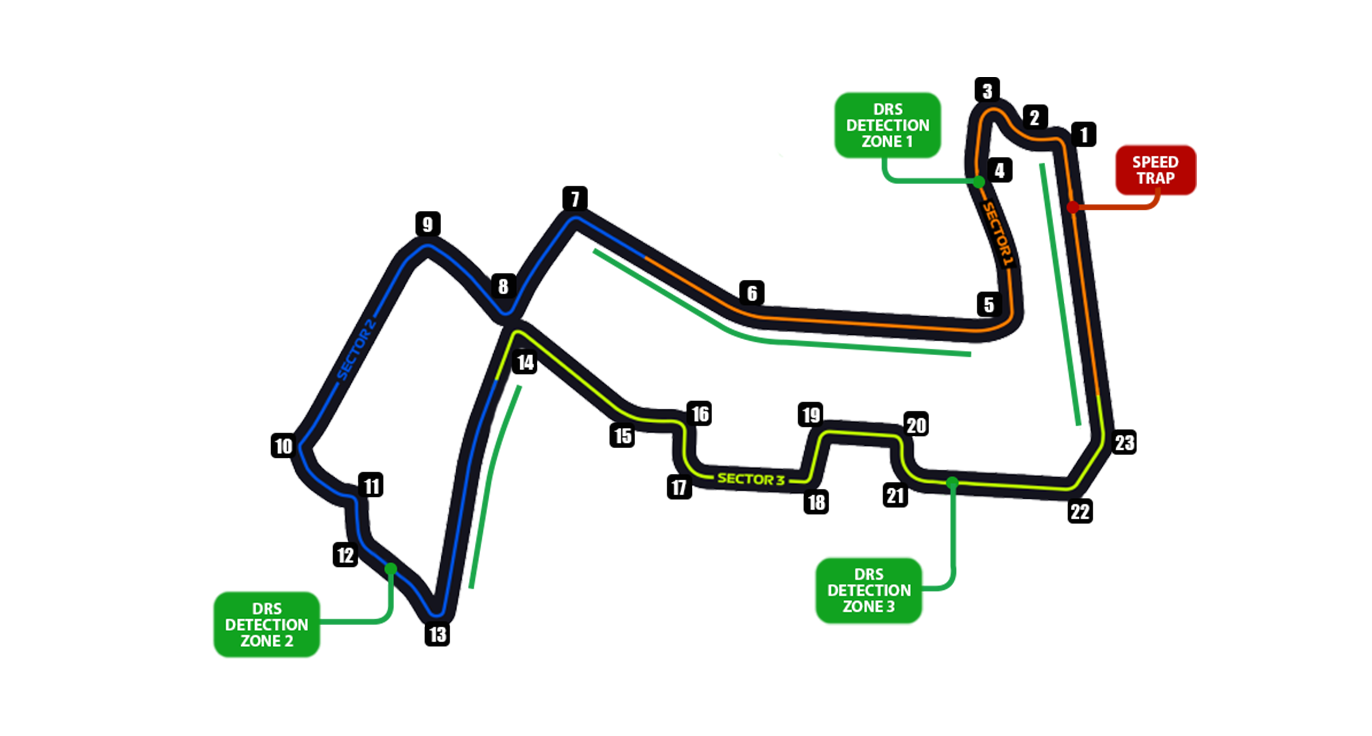
- The 23 turn layout requires high downforce. The relatively low average speed prioritizes traction and grip in the corners.
- The track passes under the Anderson Bridge and St. Andrews Street Bridge, a unique feature that creates a challenge for drivers as visibility changes and the track narrows.
- Despite the race being held at night, conditions in Singapore remain extremely hot and humid.
- The circuit has been modified: The “Singapore Sling” chicane has been eliminated and turns 11 and 12 have also been modified.
- The official race lap record is held by Lewis Hamilton (Mercedes), with a time of 1:36.015, set in 2024.
- The circuit, with its 4.940 kilometers in length and 16 corners, requires 61 laps to complete a total distance of 301.994 km.
- The first winner of the Singapore Grand Prix was Fernando Alonso (Renault) in 2008.
- Due to its tight corners and lack of long straights, it has the lowest average speed, which poses a technical challenge.
- The circuit has a high probability of a safety car due to the nature of the layout, its barriers, and the lack of wide runoff areas.

























 ?? : UNKNOWN
 ?? : UNKNOWN
 ?? : UNKNOWN