2001
Fernando Alonso's 2001 season in Formula 1 marked his debut in motorsport's top flight. Racing for the Minardi team, Alonso found himself in a challenging situation as the team did not have a competitive car compared to the top teams on the grid. Despite these difficulties, Alonso began to demonstrate his talent and skills as a driver in a highly competitive environment.
Throughout the season, Alonso faced the typical learning curve of rookie drivers, adapting to the rigors of Formula 1 and the demands of elite racing. Although Minardi's car was not in a condition to compete for the top places, Alonso managed to show his determination and ability to maximize the team's performance at every opportunity.
Despite failing to score points during the season and facing a number of competitive and technical challenges, Alonso began to attract the attention of Formula 1 observers. His ability to stay competitive despite the limitations of the car and his focus in personal and professional development they laid the foundations for his later success in the category.
2002
Fernando Alonso's 2002 season in Formula 1 marked his second year in the category, competing with the Renault team. Although still a young and relatively inexperienced driver, Alonso began to show glimpses of his talent and skills on the track. Despite the fact that the Renault car was not the most competitive, Alonso demonstrated his ability to maximize available resources and fight in the midst of intense competition.
During the season, Alonso had some standout moments in the races, demonstrating his ability to handle changing situations on track and to overcome technical challenges. Although he failed to finish on the podium or score points that season, his performance caught the attention of the Formula 1 community and laid the foundation for his subsequent success in the series.
The 2002 season was an early chapter in Alonso's career, in which he began to establish himself as a driver to be reckoned with in the future. His ability to compete in difficult conditions and to work together with his team of engineers and mechanics paved the way for his subsequent rise in Formula 1. Although it was not a season of outstanding results, it was an essential step in his evolution as a driver and on his way to success in motorsports.
2003
Fernando Alonso's 2003 season in Formula 1 marked his third year in the series and his first full year with the Renault team. It was a year in which Alonso began to show his true potential and abilities as a driver in a more competitive environment. Throughout the season, Alonso showed his ability to fight on the track and to maximize the performance of his car in different conditions.
Despite the fact that the Renault was not the fastest car on the grid, Alonso achieved several impressive results. He especially excelled in races where circumstances were changing, demonstrating his ability to make strategic decisions at the right time. His first victory at the Hungarian Grand Prix was a significant milestone in his career, making him the youngest driver to win a Formula 1 race up to that point.
In addition to his victory in Hungary, Alonso was on the podium on two other occasions during the season. His consistency and driving skills saw him finish sixth in the drivers' championship, an impressive achievement given the circumstances and the competitiveness of the grid.
The 2003 season marked the beginning of a new stage in Alonso's career, in which he demonstrated his potential to compete at the top of world motorsport. His ability to overcome challenges and seize opportunities on the track laid the foundation for his subsequent rise in Formula 1 and his success for years to come.
2004
Fernando Alonso's 2004 season in Formula 1 marked his second full season in the category, again racing for the Renault team. It was a year in which Alonso continued to demonstrate his evolution as a driver and his ability to deal with the challenges presented by elite sport.
Despite the fact that the Renault was not one of the most competitive cars on the grid, Alonso managed to stand out on several occasions. Throughout the season, he demonstrated greater consistency and maturity in his on-court approach, which translated into stronger results. Although he failed to score wins or podiums, his ability to maximize available resources and to overcome the car's technical limitations was evident.
The 2004 season also saw Alonso challenge his teammate Jarno Trulli in an internal battle for the leadership of the Renault team. Despite the competition, Alonso kept his focus and managed to outperform his teammate in terms of points and overall performance.
Although the season was not particularly outstanding in terms of on-track results, Alonso continued to forge his path in Formula 1 by showing his ability to deal with the challenges and expectations that come with competing in such a competitive category. His evolution as a driver during this season prepared him for future seasons in which he would achieve a greater level of success and recognition in the category.
2005
The 2005 season was also highlighted by the rivalry between Alonso and McLaren's Kimi Räikkönen. The title fight between the two escalated into several exciting races, creating an exciting narrative throughout the season.
Finally, Alonso achieved his first world championship in Formula 1 by winning the title at the Brazilian Grand Prix. His consistency, driving skills and tactical approach proved instrumental in his success. He became the youngest driver to win a world championship to that point and solidified his status as one of the sport's rising stars.
Alonso's 2005 season left an indelible mark on Formula 1 history and established his position as one of the most talented and successful drivers of his generation. His ability to compete at such a high level at a young age set the stage for a career in which he would continue to garner achievement and admiration for years to come.
2006
From the start of the season, Alonso showed his intention to repeat his success from the previous year. He achieved impressive victories in key races, demonstrating his ability to lead on the track and manage challenging situations. His close relationship with his team and his ability to understand and develop the car were crucial to his success.
One of the highlights of the 2006 season was the battle between Alonso and Ferrari's Michael Schumacher. The fight for the championship was intense and lasted until the last race in Brazil. Despite the pressure, Alonso demonstrated calm and composure, securing the world champion title for the second year in a row.
Alonso became the youngest driver to win two Formula 1 world championships and solidified his position as one of the most prominent names in motorsport. His ability to compete at such a high level and to stay focused in the midst of intense competition reinforced his legacy as an exceptional driver.
2007
After two successful seasons with Renault, Alonso joined the McLaren team to compete alongside his teammate, Lewis Hamilton. However, this season was marked by internal rivalries and controversial moments that impacted his performance and relationship with the team.
From the start, Alonso found himself in a competitive situation with his fellow rookie Lewis Hamilton. Despite the fact that the McLaren-Mercedes was a competitive car, the internal rivalry between Alonso and Hamilton created tensions within the team. Throughout the season, there were incidents and disagreements on and off the track, which affected the dynamics of the team and Alonso's focus on his performance.
Despite the challenges, Alonso managed to take victories in races such as the Malaysian Grand Prix and the European Grand Prix. However, the tension in the McLaren team and the rivalry with Hamilton had an impact on his quest for the championship. Alonso finished the season in third position in the drivers' championship, behind Ferrari's Kimi Räikkönen and Hamilton.
The 2007 season was a year of ups and downs for Alonso, in which his driving skills and his ability to compete at the highest level were indisputable. However, internal challenges and problems in the team affected his overall performance and his enjoyment in the series.
2008
Alonso started the season with Renault, knowing that the team did not have a car capable of competing for the title. Despite this, he managed to demonstrate his talent by taking victories in unpredictable and challenging races, such as the Japanese Grand Prix. Throughout the season, he showed his ability to maximize the car's performance in changing situations and managed to finish on the podium on several occasions.
Although he did not fight for the championship, Alonso maintained his commitment to the team and demonstrated his ability to motivate those around him despite difficulties. His experience and technical knowledge also played a key role in developing the car and seeking performance improvements.
2009
The 2009 Renault car was not as competitive as in previous seasons, which posed difficulties for Alonso and the team. Despite technical and performance challenges, Alonso demonstrated his ability to get the most out of the car in difficult situations. His determination and driving ability led to points in several races throughout the season.
One of the highlights of the 2009 season for Alonso was his victory at the Singapore Grand Prix, a night race that presented unique challenges. The victory demonstrated his ability to adapt to different track conditions and to capitalize on changing situations.
Although the season did not allow him to challenge for the championship due to the dominance of Brawn GP and Red Bull Racing, Alonso finished ninth in the drivers' championship. His commitment to the team and his ability to stay motivated in a challenging environment reflected his professionalism and focus on long-term development.
2010
Alonso started the season promisingly, showing his adaptability and driving skills by consistently taking podiums and points. His victory at the Bahrain Grand Prix catapulted him into contention for the championship from the start of the season. As the season progressed, he found himself in intense competition with other drivers and teams, including Red Bull Racing's Sebastian Vettel and his teammate Felipe Massa.
One of the highlights of the 2010 season was the exciting final race in Abu Dhabi. Alonso came into this race in contention for the championship, but ultimately lost the title by just four points to Sebastian Vettel. Although the season did not culminate in the championship, Alonso demonstrated his ability to compete at the highest level and his ability to lead the Ferrari team to a competitive position.
The 2010 season also highlighted the importance of strategy and adaptability in Formula 1. Alonso had to deal with changing situations on the track and make key tactical decisions to maximize his chances of winning. His focus on teamwork and his ability to understand and develop the car were instrumental in his success.
2011
The 2011 Formula 1 season was a challenging year for Fernando Alonso, racing with the Ferrari team. Despite his prowess on the track, Alonso failed to win the championship due to difficulties with the Ferrari car. The season was dominated by Red Bull's Sebastian Vettel, who took the title with 11 wins and 13 pole positions from 19 races. Although Alonso had a difficult start, he managed eight podium finishes and one victory at the British Grand Prix. However, a critical moment in Canada resulted in his only retirement of the season due to a collision. Despite his arduous effort, Alonso finished fourth in the final standings, which marked a disappointing outcome. The season was also marked by rule changes and the introduction of items such as Pirelli's wear-resistant tires and the DRS system for overtaking.
2012
The 2012 Formula 1 season was an outstanding campaign for Fernando Alonso, competing with the Ferrari team. Despite having a less competitive car compared to the dominant Red Bull, Alonso showed an outstanding performance. He achieved two victories at the Malaysian Grand Prix and the European Grand Prix, along with 13 podiums and 2 pole positions. His tenacious effort led him to a season total of 278 points. Although Alonso fell just short of the championship, he finished second in the drivers' championship, behind Red Bull's Sebastian Vettel. The 2012 season was also highlighted by the return of Kimi Räikkönen to Formula 1 and by a number of changes to teams and drivers.
2013
In the 2013 Formula 1 season, Fernando Alonso stood out with an impressive victory at the Spanish Grand Prix. He was driving for Ferrari and led the race from start to finish. Alonso used a solid strategy and steady pace to outpace his rivals. During the race, he outperformed other competitors and maintained an advantage over the others. His victory in his home country was crucial to his championship standing and demonstrated his prowess as a driver. Although Alonso and Ferrari did not clinch the title that year, his victory at the 2013 Spanish GP was a highlight of the season.
2014
Fernando Alonso's 2014 season in Formula 1 was a difficult year for the Spanish driver.
Alonso changed teams, leaving Ferrari to join McLaren
Overall, it was a difficult season for Alonso, as he failed to take any wins or pole positions. He finished in sixth place in the drivers' championship.
Results of Fernando Alonso in the 2014 season:
Australian Grand Prix: Finished in position 4, adding 12 points.
Malaysian Grand Prix: Finished in position 4, adding 12 points.
Bahrain Grand Prix: Finished in position 9.
2015
Another season for Fernando Alonso in Formula 1 that was challenging for the Spanish driver.
With the McLaren team, the season was difficult due to technical problems with the car and a lack of competitiveness.
Despite the challenges, Alonso insisted that this season was necessary to regain his motivation and fight again for the top positions.
McLaren struggled throughout the season, only managing points twice in the last nine Grands Prix.
Despite the adverse results, Alonso maintained his confidence in the team and anticipated that McLaren would be very competitive in the 2016 season.
There were no wins, podiums or pole positions for the season, and Alonso finished in 17th position in the drivers' championship Alonso closed the year with 11 points.
2016
Despite expectations of improvement, the 2016 season was also a difficult one for McLaren. The car was not competitive enough and Alonso had a hard time getting good results.
Throughout the season, he managed to get some standout results, including a fifth-place finish at the Monaco Grand Prix and a seventh-place finish at the United States Grand Prix.
However, there were also difficult moments. At the Australian Grand Prix, Alonso suffered a spectacular accident that forced him to miss the next race.
Despite the challenges, Alonso maintained his confidence in the team and expressed his belief that McLaren would be very competitive in the following season.
In the drivers' championship, Alonso finished in eleventh position with 50 points.
2017
The 2017 season was also a difficult one for McLaren. The car was not competitive enough and Alonso had a hard time getting good results.
Despite the challenges, Alonso demonstrated his skill and determination on several occasions. At the Hungarian Grand Prix, he managed to get a sixth place, showing his talent in a difficult race.
Throughout the season, Alonso had to deal with technical problems and retirements in several races, which affected his overall performance.
Despite the difficulties, Alonso maintained his commitment to the team and expressed confidence in McLaren's long-term project.
In the drivers' championship, Alonso finished in 15th position with 17 points.
2018
Fernando Alonso's 2018 season was a year of changes and challenges for the Spanish rider.
Despite having an uncompetitive car, he managed to get some good results throughout the season.
At the Australian Grand Prix, he finished fifth, showing his skill and determination.
Throughout the season, he had to deal with technical problems and DNFs at various races, which affected his overall performance.
At the Singapore Grand Prix, Alonso managed to score points again, being his last race of the season in which he scored points.
Despite the challenges, Alonso was pleased with McLaren's sporting project and his association with the team.
In the drivers' championship, Alonso finished in eleventh position with 50 points.
On August 14, Alonso announced his decision to leave Formula 1 at the end of the season. The Spaniard contested his last race in the premier class on November 25, the Abu Dhabi GP, where he finished eleventh.
2019
This was a season of absence for Alonso in the highest category.
2020
The return of Fernando Alonso to Formula 1 in 2020 announcing his signing by Renault (currently Alpine) After he left Formula 1 in 2018. Step after his retirement in various competitions and commitments in the motor world.
Fernando ALonso prepared himself in his adaptation with several private tests with the Renault. In October with the RS20 he was able to test the features on a 'filming day' at the Circuit de Barcelona-Catalunya.
He then took part in post-season testing in Abu Dhabi after the end of the season driving the R25 in a show at Yas Marina fifteen years after his first Formula 1 title.
2021
This season Fernando Alonso materializes his return to the highest category with the Alpine team (formerly Renault) being the partner of French Esteban Ocon.
His start was notable with his entry into Q3 at the start of the season, Fernando had several appearances scoring important points for the team.
The most exciting race with his best result was Qatar, where he was able to get a podium finish after his fight against Sergio Pérez's Red Bull.
Alonso finished his season seven points higher than Esteban Ocon, in addition to being in the top ten. An unforgettable season for a pilot with a great career.
2022
Fernando started the year with good results, great performances in Bahrain, Saudi Arabia or Australia, but it didn't take long for mechanical failures to arrive that frustrated several results in the season. This season Alpine had the new direction of Otmar Szafnauer.
This season in which he came to lose many points due to these problems, with six withdrawals and two from Esteban Ocon.
The best results of the season were three fifth places, achieved in Great Britain, Belgium and Brazil. Fernando managed to link ten consecutive Grand Prix in points... and the run was frustrated by a break.
A difficult season with major clashes on and off the track with his partner, in addition to discussions and reaching an understanding with Otmar Szafnauer, Laurent Rossi, Luca de Meo and other characters led Fernando Alonso to make the decision to leave the team to leave. to the Aston Martin team where he fit very well in a promising project and where there was a free vacancy thanks to the retirement of Sebastian Vettel.
2024
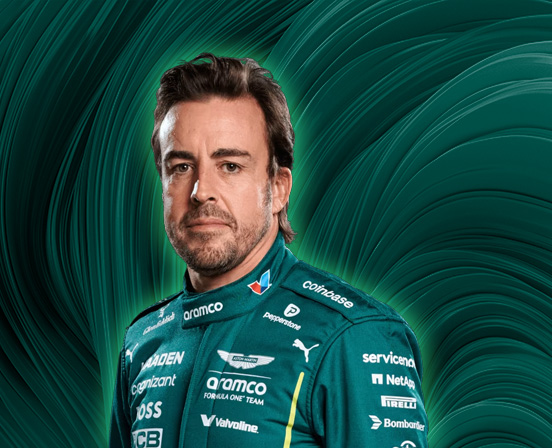
In the 2023 Formula 1 season, Fernando Alonso enjoyed a standout campaign with Aston Martin, making an impressive return to the podium fight. From the start of the season, the Spaniard showed his prowess by taking several podium finishes, including a third place at the Bahrain Grand Prix.
The AMR23 he competed with proved to be a very competitive car, allowing Alonso to maintain a strong pace against bigger teams. Despite some ups and downs throughout the year, he remained consistent and was crucial in helping Aston Martin position itself among the top midfield teams. With his experience, Alonso also excelled in race management and strategy. Although he did not score any wins, his performance in 2023 reaffirmed his place as one of the most talented and competitive drivers in F1.
2024
In the 2024 Formula 1 season, Fernando Alonso faced challenges with the Aston Martin AMR24. The team failed to repeat the performance of 2023, with the AMR24 lacking podium finishes and finishing fifth in the Constructors’ Championship with 94 points. Alonso, however, showed his ability by scoring valuable points, highlighting a fifth place in Saudi Arabia. Despite expectations, the car’s performance declined after a promising start, affected by technical issues and difficulties in implementing effective updates.
Alonso remained optimistic, highlighting the addition of engineer Adrian Newey to the team and internal restructuring as steps towards greater competitiveness in the coming seasons. At the conclusion of the season, Alonso expressed his readiness for 2025, acknowledging the difficulties of the year but confident in the team’s future progress.




 ASTON MARTIN
 MERCEDES
 PIRELLI
 ALPINE
 RENAULT
 MCLAREN
 HONDA
HONDA FERRARI
 BRIDGESTONE
 RENAULT
 MCLAREN
 MICHELIN
 MINARDI
 EUROPEAN
 AUSTRALIA
 CHINA
CHINA JAPAN
JAPAN BAHRAIN
 SAUDI ARABIA
 MIAMI
MIAMI E. ROMAGNA
 MONACO
 SPAIN
SPAIN CANADA
 AUSTRIA
 GREAT BRITAIN
 BELGIUM
 HUNGARY
 NETHERLANDS